Monday, February 06, 2012

Summer Holidays

There is always a sense of excitement when the summer holidays are booked.  Today we booked our flights and are heading north west into some of the finest sea kayaking waters in the world. Disko Bay, Greenland.  We will spend 3 weeks exploring this pristine environment off the west coast of this Arctic Island.  4 of us have been before but for 2 of the group it will be a totally new experience.
We meet in Copenhagen on Saturday 21st July, ready to embark on what will probably be the highlight of our sea kayaking year.

 Uummannaq Island, courtesy of British Airways en route to Seattle. The red gneiss peak dominates the village which is reputed to be the sunniest spot in Greenland.  We are flying into here on a helicopter to pick up the sea kayaks.
 Qaarsut, on the northern side of the Nuussuaq Peninsula, nestles in the broad valley.  The runway is just visible to the left of the valley.  The population is just 240 and hopefully we will be able to call in here to catch a glimpse of life in a small settlement.
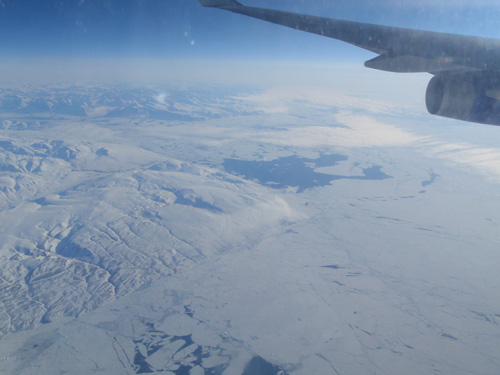
 
 The western end of the Nuussuaq Peninsula.  The open water is at the western entrance to the Vaigat, the channel we will follow into Disko Bay.  The land in the distance is Disko Island, which we hope to visit for at least a day.
One of the pleasures of kayaking in Greenland is the way that bergs are eroded, creating a magnificent backdrop.
 With views like this from the camp sites in the evening it is hard to think of places which are more dramatic for sea kayaking.
 Looking across towards Disko Island, hopefully a visit is possible but it will be necessary to dodge the numerous bergs which are heading towards the Davis Strait.
 Nicky enjoying Disko Bay sea kayaking.  Looking forward to another 3 weeks this summer.

Sunday, February 05, 2012

Canoeing and Kayaking Books

I have finally completed cataloging my paddling book collection as I was finding it more and more difficult to keep track of the titles I already owned so deciding whether to buy a particular title when it became available was a real challenge.   My final tally was 539 titles, the challenge now is to ensure that it is kept up to date as each new title arrives through the door.
It has proved to be a fascinating exercise and I re-discovered many kayaking gems which I had read years ago but which had slipped from my memory over the years.  In particular I have been motivated to read again many of the books which describe canoeing on the rivers of North America, some from the early part of the 20th century whilst others are more recent. One of my favourite paddling books of all time must be "Water and Sky" by Alan Kesselheim, it is well worth seeking out a copy.
Although it is not a definite bibliography of canoeing and kayaking it is a fairly comprehensive list so if anybody would like a copy, perhaps as a starting point for their own collection, then please get in touch and I will forward you a copy.

 A selection of sea kayaking titles, most from North American authors, although clearly there are a number by British authors such as Derek Hutchinson.  The sea kayaking titles alone occupy nearly 4 metres of shelf space on their own.
 A few recently acquired titles including a French sea kayaking manual.  The older titles, for example the classic "Canoe in Australia" by Raven Hart, first published in 1948 can often be found in sites such as ebay but regular monitoring is required plus a pre-set budget otherwise you could get really carried away. 
 The glass fronted bookcase for some of the more delicate/valuable titles.  This was a necessary purchase as I ended up with quite a valuable title in 1996 which I wanted to protect.  A first edition of "Northern Lights" by Spencer Chapman, which is signed by the author and inside was the original cutting from The Times of the 7th September 1932 announcing the death of Gino Watkins, whilst kayaking off the east coast of Greenland.
I did tell the BCU about the book, as it was in an antiquarian book sellers in London, and I happened to be at a meeting in Nottingham later the same day.  The BCU declined the offer of this important title but fortunately my wife decided to purchase the book for Christmas for me.

Many people are surprised by the number of paddling books which are available and it is a market which is growing all the time.  It is just another aspect of this hobby of ours.

Saturday, February 04, 2012

A Gneiss Paddle

Just under 3 miles north of Greve de Lecq lie the Paternosters, a reef which for many sea kayakers offers their first opportunity for heading offshore.  Although the tidal streams can run with surprising speed towards low water the crossing can be reasonably direct and straightforward, which is what we had planned for today.  Leaving just before low water slack and hopefully taking a fairly direct route.
At high water only four summits are left protruding from the swirling waters but at low tide an extensive reef is uncovered.  Great Rock, which is ten metres high and Sharp Rock, four metres high, are the largest rocks and are situated in the middle of the bank.  Our plan was to have a drink and some food on the north side of Great Rock in the weak winter sunshine, taking advantage of a lull in the wind before the possible gales arrived in early evening.
The origin of their name is said to be due to a ship on its way to Sark, in the 16th century, striking one of the rocks and a number of women and children drowning.  As a result it became common practice for fishermen to say a Pater Noster or a prayer as they passed close to the reef.  Although they have two names it is the Paternosters that has been accepted into everyday use.  A more recent ship wreck occurred on the 16th September 1961.  A Dutch owned vessel, the Heron was en route to Portsmouth when it sank, with the loss of 3 lives.  The wreck lies in about 30 metres of water to the south of the reef.

On the beach at Greve de Lecq, ready for departure.  The Paternoster's are visible on the horizon, just over 2.5NM offshore.
 Heading out from Greve de Lecq, the Pats visible on the horizon.  This is one of a number of photos taken using a GoPro.  I used on the setting for one photograph every minute, I kept a few with most in the Trash.
 John the "Commodore" of the Jersey Canoe Club approaching the Pats.  Although it was an impromptu paddle we still had 11 members turn up.  Not bad for a morning when the temperature was below freezing.
 Even closer to the reef.  The white kayak is a late 1970's Anas Acuta which was virtually buried for years but about 18 months ago was dug up, it has been refurbished and is as good as new.
Ideal paddling conditions for the first weekend in February.
The classic approach to the Paternosters, a ferry glide.  The tide was just starting to run from right to left. A well known jump is from near the summit of the main rock.  Conditions were a bit too cold for such activity today.
 I explored the north side of the reef and then threaded my way through some shallow channels.  Other members of the group are visible just above the bow of my kayak.
Looking down from the highest point of the reef.  The rocks are gneiss which is metamorphosed granite, a type of rock which isn't seen anywhere on the main island of Jersey.
 We are about to jump on the tide towards Plemont headland.  Although it was only a neap tide we averaged 5 knots on the 2NM crossing to Plemont headland.
 From this distance it was difficult to distinguish most of the details of the Jersey coastline.
Looking along the coast.  Mainly in the shade but with a few glimpses of the sun through some of the gaps in the cliff top.
Nicky heading along the coast.  We had seen numerous Razorbills along this section of the coast plus some very inquisitive Fulmars.
Landing back at Greve de Lecq, a great morning out followed by a well earned pint in front of the fire at the Moulin de Lecq.

Friday, February 03, 2012

A Quick Reminder

As we hope that winter is perhaps having her last attempt to keep us off the water many paddlers thoughts are turning towards the warmer months of summer.  I have received numerous e mails about potential sea kayaking in the Channel Islands, which I am always prepared answer but if you are interested in paddling in Britain's south sea islands then why not have a look at the Sea Kayaking Guide which is available for the Kindle and other e readers from Amazon.
Comments will be appreciated.
We look forward to seeing you in the Channel Islands in 2012.

Thursday, February 02, 2012

More Capital Paddling

The second day of our kayaking in the heart of London required a much earlier start as we were heading down stream on the last of the ebb tide.  It was a bright sunny morning after a wild night, wind wise, at the Shadwell Basin.  We were carried past Canary Wharf and Greenwich until we were just passed the O2, by now the tide had turned and it was time to head back up stream.
We landed in Greenwich, quite an amazing experience, leaving the kayaks on the river front walk whilst we retreated to the warmth of the local pub, for lunch.  It is impossible not to be impressed by the maritime traditions of this London suburb.
When it came to launch the rising tide had covered our friendly beach and it was quite entertaining to launch down the steps.  We were quickly carried up the west side of the Isle of Dogs, arriving back at Shadwell Basin for quite a tricky landing.
Kayaking in London is far more interesting than it seems at first sight.  Fast moving streams, vertical walls preventing easy access and moored obstacles create an environment which is challenging for paddlers.  Safety procedures and group control need to be sorted out before launching because once on the water it is all too easy to be distracted by the world famous historic views, which are continually changing.
If you have not been kayaking on the Thames before it is well worth considering for a weekend visit.

 The unique skyline of Canary Wharf
 
Residential waterfront developments are certainly different to the granite cliffs I normally paddle alongside.
 
The O2 from the water.
 
Kayaks almost blocking the footpath at Greenwich, they certainly generated interest amongst the walkers in the area.
 Launching at Greenwich.  There was quite a bit of chop bouncing off the steps.
 Landing back close to Shadwell Basin.  Not the people in the water helping the kayaker.
 
Landing was not easy.  It was a matter of making sure that your arrival coincided with a lull in the swell which was generated by the numerous passing ferries.  A bit of a sting in the tail.
  The end of a great day out in one of the worlds major cities.

A Capital Idea

There has always been something appealing about paddling through the great cities of the world, seeing instantly recognizable landmarks form a totally different perspective.  It had been probably 25 years since I had paddled through the centre of London, two Devizes to Westminster finishes don't really count.
We headed upstream from Shadwell Basin, aware of the risks of being on the water. It was the moored barges and ships which possibly created the greatest hazard, being swept into those just didn't bear thinking about. 
We paddled upstream as far as Vauxhall Bridge where we headed off in search of meal, surprisingly we managed to find a restaurant which was prepared to take 16 kayakers in wet kit, and managed the service with efficiency and a smile.
Heading back downstream we were able to take full advantage of the ebbing tide, arriving back at Shadwell Basin as darkness descended on the river.  
A great day in the heart of one of the worlds great cities.
 Leaving Shadwell Basin the familiar landmarks of London soon came into view.
St Catherines Dock was one of the first docks to be refurbished after the Port of London started to close.  Today it remains as busy as ever and we had to wait for a number of private vessels to leave through the lock gates.
HMS Belfast moored on the opposite bank of the river.  Later in the afternoon we would need to exercise great care as the ebbing tide swept us towards this proud ship.
 Just upstream of Tower Bridge we passed the Tower of London and the Traitor's Gate.  A perspective which most tourists don't get.
 Passing the London Eye, there were plenty of interested tourists looking out over the river.
Standing on the river bank close to Vauxhall Bridge, we were about to head off on search of a restaurant for lunch.

Crossing the road in full kayaking gear certainly attracted a significant amount of attention from passing motorists.

Heading down stream after a superb lunch in a restaurant, although we did leave a significant number of puddles on the floor as the kayaking kit dried.
Passing underneath Tower Bridge as darkness started to settle over the city.  The end of a great day.

Tuesday, January 31, 2012

Don Starkell

As many people know I am an avid collector of books related to canoeing and kayaking and two of the most memorable paddling books were written by Don Starkell.  I remember reading "Paddle to the Amazon" in the early 1990's and inspired by what he had achieved with his sons, it encouraged me in my own small way to take my children canoeing on North American rivers.


Sadly Don died on Saturday at his home in Winnipeg, aged 79.  He probably traveled further than any other paddler, with his journeys recorded in journals.  To read more about his life see the full article at "Canoe and Kayak".
A truly inspirational paddler.

Monday, January 30, 2012

Milos Again

In October 2010 Chester and myself from Absolute Adventures organized a circumnavigation of Milos, that well known sea kayaking island in Greece, to raise money for Jersey Hospice and Centre Point Trust.
A total of 30 kayakers, from Jersey, headed towards southern Greece for the last week of October and we were blessed with some excellent weather at the beginning of the week, followed by some more entertaining conditions.

 Sulphur Mine on the east coast of Milos.  A great spot for a break and a swim, even in October.
 Cooking porridge on the west coast of the island, after a night of violent storms.  Tents were flattened, sea kayaks blown along the beach and the night sky lit by lightening storms.
 Kleftico.  The south west corner of the island with a superb range of arches and stacks.
 The final day along the south coast.  Clouds of this size produce entertaining squalls!
 Sarah proving that even after a night on the beach it is possible to look reasonably glamorous.
On the north coast of the island.  Ideal conditions for exploring the geological features.

In October 2011 we are returning to Milos again with the aim of raising more money for these two charities so if you are interested in helping to raise funds whilst paddling in one of Europe's great sea kayaking destinations why not get in touch.  Contact myself for further information and consider heading south this autumn.

Sunday, January 29, 2012

Ecrehous for the first time in 2012

Looking at the weather forecast on Thursday it looked like a window of opportunity might arise for a quick Ecrehous trip today, and what a window it was.  An early morning departure from St Catherine's was greeted by a stunning sunrise.

 Apart from a couple of lifeboats, one from France and one from Jersey, plus the Channel Islands Air Search plane we had the reef to ourselves, something which never happens in the summer.  Fortunately the lifeboats were only training.
 Looking across towards Marmotier, although it wasn't a particularly large tide, two hours earlier we had been playing on standing waves where now there were only shingle banks.
 Jersey in the distance with the distinctive shape of Mont Orgueil Castle.  It was like paddling on mercury, as we headed back towards the island.
 This is what sea kayaking in January is all about.  Seas this flat almost never occur even in the height of the summer.
My first visit to the reef this year was particularly memorable, snatched between two windy periods.