Thursday, February 16, 2012

Jersey Towers

One of the more unusual characteristics of sea kayaking around the Jersey coastline are the significant numbers of Jersey Round Towers, which punctuate the coast at regular intervals.  In 1781 a French force under the command of Baron de Rullecourt, landed at La Rocque, the south east corner of the island and marched as far as St Helier before being defeated in the Battle of Jersey, in the Royal Square.  This was too close to French success for the authorities so they embarked on a programme of building coastal towers around the island.
Many of these towers survive and provide a historic backdrop to sea kayaking in Jersey's coastal waters.
Seymour Tower, built in 1782, was the first tower to be built following the French invasion.  In complete contrast to all the other Jersey Round towers it is square in shape.  Built approximately 1 mile offshore it is a fascinating paddle when the tide is in, or walk on low water springs when the shore dries.
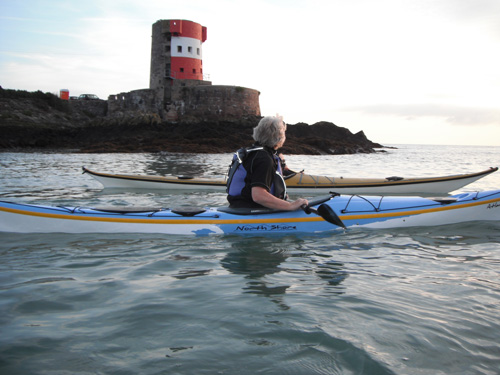
 Nicky paddling out of Archirondel early one morning.  We were actually on a photo shoot for Jersey tourism, who were keen to publicize the sea kayaking opportunities in Jersey .  Our only venture into the world of modeling.  The tower was completed in 1794 and in common with so many other towers around the island is now painted as a navigation mark.
The south east corner of the island with its shallow waters, sandy beaches and shelter from the prevailing wind was the favoured location for another French invasion.  Built in the 1780's it was one of many which helped to protect this section of coastline.  In all 23 towers were built by Sir Henry Seymour Conway, who was Governor of the Island.
Not all of the towers have survived the passage of time.  At L'Etacq a tower was blown up during the German occupation of the Second World War to make way for a bunker, which is now used by a local fisheries company. 
Built offshore, in St Ouen's Bay, La Rocco Tower is probably the most photographed of all the Jersey Towers and the last of Conway's Towers to be built.   When paddling around Jersey I generally leave from Corbiere, to gain maximum benefit from the tide and La Rocco is a welcome sight as it is less than a mile from the finish, with over 28 nautical miles already under your belt.  A great feeling.

Wednesday, February 15, 2012

Coasteering Conference

Coasteering is one of the most exciting activities which it is possible to do with either friends or whilst leading groups.  I first started exploring the Jersey coast by swimming, scrambling and jumping in 1969 and have continued to do so regularly up to the present time.  We were coasteering before it was called coasteering and have certainly never called it tombstoning.
We just wanted to have a good time and reach places which most people had never seen.  I first started leading groups of school children in 1980, when it was a much simpler time, I don't think that we had ever heard of a risk assessment, although we were automatically continually assessing our location and the possibility of injury, it was something that came with experience.
The last few years have seen an explosion in participation.  Either through the commercial sector, with numerous companies offering the coasteering experience or unfortunately the largely drink induced jumping from great heights with at times unfortunate consequences.  As a result the authorities have taken an interest in this activity and largely through lack of knowledge have started to attempt to regulate the activity.  For example, pier jumping is now banned in Jersey but it is something we had done safely with thousands of young people for nearly 40 years.  It isn't going to stop young people jumping, it just means that we can't offer training to ensure that they do it safely.  
One positive move forward that is that a number of providers from around the country have got together to create what is known as the National Coasteering Charter.  Have look at the RoSPA website for the press release as well as being able to download information on skills and competences.
In the Channel Islands we have our inaugural conference on Saturday 17th March in Jersey between 10.00 and 16.00, with both talks and a practical session.  We are trying to get as many people to attend as possible from the commercial sector, voluntary organizations, education etc and best of all it is free.  So if you are interested in attending please contact me for further information.   
By tracking the visitors to the site it is possible to see that a significant number of visitors to the site live in Jersey or on our sister island, Guernsey, so there no apologies for putting on something which might see quite parochial.

Tuesday, February 14, 2012

A-Z of Sea Kayaking

Many thanks to everybody who has purchased a copy of my e book "The A-Z of Sea Kayaking" from Amazon in the UK or from amazon.com.  It comes out at nearly 300 pages long and I wrote it initially for the Kindle but it can be read on a variety of other devices if you download the Kindle App.
I have attempted to put as much information as possible in the book about topics as varied as personalities, skills, history, equipment etc.
I know that there is something very satisfying about having a book in your hands but the e book format enables the books to be sold for less and so it is possible to buy titles which you may not have considered otherwise.
It is also a very convenient format whilst away on longer trips.  Last year we did a two week paddle through the Greek islands and on my Kindle I was able to have my reading books, the Sailing Directions, a tourist guide, ferry timetables, copies of maps and charts plus some other items all on one device smaller than a paperback book.  Ideal when space is at a premium.

Sunday, February 12, 2012

Something Different

My perception of the British mountains is that they are far more crowded than in previous years, when I used to wander around the hills as a young instructor, but I was amazed today by the lack of other people on the Langdale Pikes, the first Sunday of the school half term.
After the walk up from the valley, following the course of the stream, we left Stickle Tarn and headed around to the north east side of Pavey Ark, where we found some great ice to play around on, whilst heading towards the summits. Living in Jersey I don't get much opportunity to use my crampons, so it was a truly memorable day.
From when we left Stickle Tarn until we reached the New Dungeon Ghyll nearly 5 hours later we only saw 8 other people.
Nicky heading towards Stickle Tarn, it appeared that there was a temperature inversions as we climbed out of the valley clouds into clearer air.  The summits were still shrouded in low cloud.
Just past Stickle Tarn it was time to put on the crampons, it had been a few years since they had last been used so we wanted to check their reliability before we headed onto steeper ground.  We had this area virtually to ourselves.
We threaded our way up narrow funnels of ice.  Always fun but the consequences of a fall were minimal.  Great fun.
As we climbed higher the visibility deteriorated, but climbing over the mixed ground remained entertaining.
After crossing over Pavey Ark and Harrison Stickle we dropped out of the cloud and easily found the start of the path to Dungeon Ghyll.
We quickly lost height and the stunning panorama of Langdale came into view.  The end of a great day out.

Mountain Equipment Hielo 2 Tent

Its not that often in Jersey that there are temperatures low enough to test out your cold weather equipment.  Last night temperatures drop to -4.5 ° C which is very unusual for Britain's south sea island.
We have just purchased a new tent for our summer trip to Greenland so it seemed like too good an opportunity to miss camping last night.
We decided upon the Mountain Equipment Hielo 2 as there was some amazing offers, price wise, and it seemed ideal for what we were planning to do.  We hadn't had the opportunity to put the tent up before but even in the dark we had it pitched in under 5 minutes.  Perhaps the cold acted as extra incentive.  Once we were in the tent it was surprising how spacious and stable it was.
The four poles threaded quickly through the sleeves, in complete contrast to the last tent I had,  which was an absolute pain to put up and virtually impossible to put up on your own.  I used it in Greenland and then abandoned it after a Greek gale, after years of using great tents from this manufacturer I don't want to disclose their name.
There were immediately obvious a number of small things which showed attention to detail.  Luminous zipper pulls, ventilation in the roof which could be closed, two reasonably sized porches, ideal for paddling kit, the continuous pole sleeves for easier pitching, mesh storage pockets etc.
So one night in a garden in St Brelade isn't a thorough test but the next time we use it will be in Scotland in April and I feel certain that it will meet all the demands placed on it, before we head to the Arctic in July. 

Saturday, February 11, 2012

Arctic Sea Kayaking

I have been slowly going through my slide collection and scanning in a few of the more memorable sea kayaking shots and have put together this group of pictures of one of my first sea kayaking trips when we paddled the length of the west coast of Spitsbergen over a period of 2 months.
We encountered a wide range of conditions and almost no other people.  It was a particularly bad summer weather wise, when we arrived at the end of June the sea was still frozen and by the end of August we were pinned in the tents in a 36 hour blizzard, the first of the impending winter.
In contrast to a lot of trips that you read about today we were relatively young, nobody was over 30 years old and I suppose the average was 25. 
It was also ground breaking in a number of ways, for example, we were as far as we were aware the first sea kayak expedition to use drysuits, they had just become available because of developments in wind surfing.
There is no escaping that it was a harsh 650 nautical miles that we paddled and looking back at the conditions we encountered it is hard to believe that things have changed so dramatically that some companies will take relative novices paddling in these waters.
It was almost the golden time of sea kayaking expeditions, with groups of paddlers heading off into distant waters, returning home to write the inevitable expedition report and give a lecture at the Canoe Exhibitions at Crystal Palace the following February.
Heading out from Longyearbyen on the first day, we were half way across a 15nm open crossing when we found that the sea was frozen.  A lengthy detour was required to make safe landfall on the northern side of the fjord.  It really was a baptism by fire.
Campsite on the first night. The winter snow drifts were still banked along the shore, making landing difficult.  We spent the evening familiarizing ourselves with the rifles which we were carrying with us in case of encounters with polar bears. 

An evening walk.  Dave, in the green jacket, has his rifle at the ready.  It was necessary to carry firearms wherever we went.
A very bleak campsite close to the Torrellbreen glacier.  Apart from out tents the scene as almost completely devoid of colour.  I remember feeling that this was a very bleak spot!
Another typical summer campsite.  We had sewn extra material to the flysheets so that they could be weighted down with stones.  It was often difficult to get pegs into the ground so we would tie the guy lines to drift wood or as in this picture, whale vertebrae.
We experienced some extended periods of poor weather, the air temperature was hovering about 0 degrees and the sea was often full of ice.  We were stuck on this beach for 3 days. 
Being stuck on beaches did allow a certain degree of creativity with the cooking.  This is instant whip being encouraged to solidify using the local ice.
The major concern for us was the possibility of an encounter with a polar bear.  We took full precautions including rifles in each tent plus alarms around the tents.  This bear (Apologies for the quality of the photo but I was still in my sleeping bag and trying to grab a rifle, as well as take a picture) had been swimming past and had come out of the sea to investigate what these strange shapes were on the beach. 
This is not sensible but we were young and foolish.
Often we would try to stay on the water for most of the day as landing was frequently very cold and once ashore we would need to have the tents up.  This wasn't ideal picnic territory.
 Just finishing our circumnavigation of Amsterdamoya.  We were just a few miles short of 80 degrees north and were starting to head back south.  At this point we hadn't seen another human being for over 2 weeks and it would be another week before we came across some Russian scientists.  In 1983 tourism had not taken off in this part of the world.
 Pete Scott and myself in front of one of the many glaciers, we had just had a very close and memorable encounter with some beluga whales.
 These paddlers (just visible) are too close to the ice front and we quickly moved away when some fairly large bits calved off.
Even on rest days we would get out and explore this pristine environment.  This was heading up one of the glaciers towards the main ice cap.

Great days, we spent two months wandering around this stunning archipelago, encountered almost no human beings and had just a superb time.


Thursday, February 09, 2012

Lihou Island

Over the last few years I have come to know a particular area of the Channel Islands particularly well, Lihou, a small island off the west coast of Guernsey.  The island is now managed by the Lihou Charitable Trust, with their enthusiastic manager and local sea kayak guide, Richard Curtis.
There is so much to see on the island that I can happily spend a week out here without feeling the need to go "ashore".  For the visiting sea kayaker there is accommodation in the form of a refurbished bunk house which has been part funded by the Jersey Canoe Club

Lihou house sleeps up to 30 people with all modern facilities.  On the southern end of the house there is a great conservatory where to pass the time of the day.  The views to the Hanois are truly memorable.  From last autumn the house has been powered mainly by solar energy.
Access is across the causeway at low tide on springs.  On neap tides the island remains cut off throughout the tidal sequence.  Then the main access is via kayak.
The house viewed through the ruins of the Priory, which was founded in the 12th century.  The island has a rich and varied history for those who are prepared to do their research.  At one time it was the largest producer of iodine in the world, as a result of burning seaweed.
Crossing to the island from the west coast of Guernsey.  Even on the windiest days it is possible to find some shelter for the crossing.  Wind against tide can create some entertaining conditions in the main channel.
This was taken on an early evening paddle towards the reefs to the south west of the island.  Next landfall after the stacks is Newfoundland, with the result that there is frequently quite an entertaining swell.  Out here on my own, I felt pretty isolated. 
To the south west of Lihou lies the Hanois, a dramatic lighthouse with a challenging landing.  On this particular day we had to swim in from the kayaks offshore, not every member of the group took up the invitation.
The Hanois is a classic lighthouse although its graceful lines have been altered due to the addition of the helicopter landing pad.  As with all lighthouses it is now unmanned but I remember visits in the 1980's when we used to deliver papers and milk on Sunday mornings.

Wednesday, February 08, 2012

Sea Kayaking Destinations

If like me you end up spending a lot of time on aircraft ( an inevitable consequence of living on an island) there are plenty of opportunities to get some unusual pictures of some classic sea kayaking destinations.  This is just a selection of some of the views I have seen over the last 30 years.  Most of them were taken either heading towards a paddling trip or coming home from one.  Great memories.

 This is possibly my oldest aerial shot.  Scanned from a slide it was taken as we approached Spitsbergen in June 1983.  We were just about to embark on a two month sea kayaking expedition along the west coast of the Arctic archipelago.  I still remember the excitement as we approached Longyearbyen, we really were heading into the unknown.  
 This is home.  It was a steep take off as we headed towards Gatwick en route to a Scottish Sea Kayak Symposium.  Although many people consider Jersey to be crowded the overall impression is still of a green island and once on the water it is possible to escape any crowds which might exist.
 This must be one of my favourite sea kayaking destinations, the Ecrehous.  We were flying back from Cherbourg, in an aircraft that was nearly 60 years old, when we were able to do a few circuits above the reef.
This is the only photograph I didn't take.  It is from the same aircraft as the Ecrehous shot though.  I do like it particularly as I am in the party of kayakers who are playing off Noirmont point on the south coast of Jersey.
The Needles and Hurst Castle Spit as we headed home one evening from Gatwick to Jersey.  Great paddling but I am almost embarrassed to admit that I haven't paddled in these waters since 1983.  I really should do something about it.
Another south coast headland, Berry Head.  Again somewhere I haven't paddled for years, the last time my paddle was dipped in these waters was 1996.
 The Solway Firth taken whilst heading home from a Scottish Sea Kayak Symposium.  We took off from Glasgow on a beautiful Sunday morning and the whole of Britain was free of cloud.
 En route to another Symposium, this time Shetland.  It was a beautiful flight up from Aberdeen with great views of Fair Isle.  It was just a pity that the weather didn't stay like this for the following week, but the beauty of Shetland is that there is always somewhere sheltered to paddle.
Another Scottish island. Stornoway from about 40,000 feet as we headed into Heathrow from Seattle.  The whole of the west coast of Scotland looked superb, it was easy to see why it is one of the great sea kayaking areas.
 Take from Ilulissat with the ice fjord just south of the town.  Views like this can't fail to excite you.

So next time you fly try and get that window seat, have your camera at the ready and hope for clear skies.

Tuesday, February 07, 2012

Egypt is not only in Africa

On the north coast of Jersey, is a small cottage known as Wolf's Lair, which is maintained by the Jersey Canoe Club.  It is located at Le Petit Port, a small rocky cove between Vicard Point and Belle Hougue.  The cottage is located in the trees just above the small cliffs and it must be the most isolated building in Jersey. Although there is a good path running down from the cliff top, the easiest access, particularly if carrying equipment is by kayak.
On a warm summers morning there can be few finer places in the Channel Islands where to eat breakfast prior to starting a days paddling. 

Although the built in the early part of the 19th Century it was in the 20th Century that the most interesting events have taken place in its vicinity.  During the Second World War it was the site of a landing by Allied troops on the night of 25th/26th December 1943.  Operation Hardtack was led by Captain Phillip Ayton. Without seeing any Germans during their brief visit the leader was seriously injured when he trod on a mine and he was to later die from his wounds.  A plaque commemorating the landing has been placed close to the entrance to the cottage.  
The second dramatic event occurred in October 1964.  The Jersey based motor yacht, Maricelia, left St Malo for St Helier.  She was caught in storm force winds with a gust of over 90 knots in Jersey.  In terrible conditions, near to Corbiere, the crew were thrown into the water, only Alison Mitchell survived.  She was carried by the tidal streams and washed ashore in this little bay after nearly 20 hours in the water.  She then managed to struggle up to Lower Egypt Farm, an incredible feat of endurance, from where the alarm was raised.
Today's visitors should have a much calmer experience in this quiet corner of Jersey, which has a special place in local sea kayaking.

Approaching Belle Hougue on an overcast winters day.  The cottage is just visible in the trees above the head of the paddler in the blue and white kayak.  Generally sheltered from the worst of the winter storms we paddle in this area fairly regularly during the shorter days between November and February.
Seen from the cliffs to the east.  The cottage is perfectly located to catch the early morning sunshine.  There is an easy landing place but it is hidden by vegetation in this photograph.
This memorial has appeared close to the cottage and on most Armistice Days members of the Jersey Canoe Club paddle here to observe two minutes silence.
Another arrival in recent years is this bench which overlooks the memorial.  The inscriptions says "In appreciation of past and present members of the Special Boat Service".

When sea kayaking in this area of the north coast of Jersey it is important to be aware of the historical significance of this little corner of the Island.