Showing posts with label Nordkapp. Show all posts

Tuesday, September 09, 2014

A swim to the Hanois

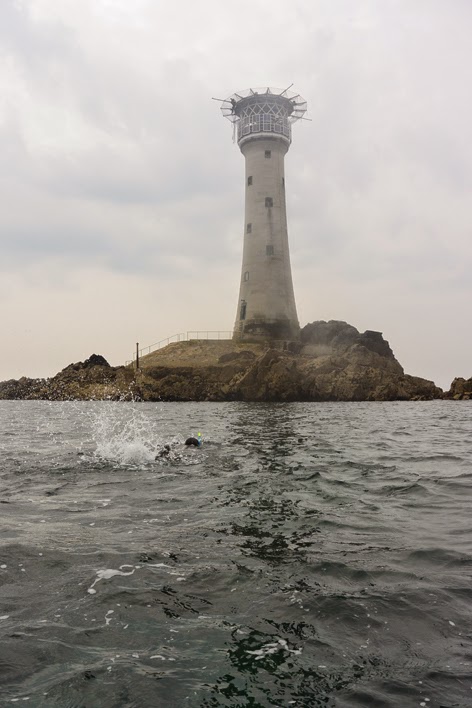
Off the south west corner of Guernsey is one of the classic lighthouses, the Hanois. We paddled out to the light in June this year, but sitting at Cobo last Saturday evening Brian Aplin explained that he had planned to swim from Lihou, out to the Hanois the following morning.  The aim was to use the southerly tidal stream to speed things along although care was needed not to be swept past the reef.
Launching from the causeway across to Lihou was probably the most challenging part of the day, the tide was dropping at quite a rate.  We joined up with Brian off the north west corner of Lihoumel and very quickly felt the impact of the tide.  Accelerating through the reefs but heading towards the Lighthouse.
Brian swam with just a couple of breaks to take on extra liquids.  On my GPS I measured the course as 2.18 nautical miles, taking him 1 hour 40 minutes to cover the distance.
I towed Brian's Nordkapp but when we arrived at the lighthouse there wasn't an easy option for him because we paddled a further 12 miles to St Peter Port.
 Joining up with Brian off the north west corner of Lihou.  He is just to the left of the closest rock.  The Hanois is barely visible in the distance.
Well under way.  Lihou is the large island on the horizon.  Brian swam in his crocs, they seemed ideal for this type of activity
 At this point I thought there was a possibility of missing the reef as the tide was pushing us south fairly quickly.  With the benefit of knowing how to ferry glide when swimming Brian did achieve the shelter of the reef.
 Almost there.  As far as we know nobody else has completed this remarkable swim.  What  a way to spend a Sunday morning.

Sunday, March 04, 2012

Some more nostalgia

In 1975 Colin Mortlock led a six man expedition along the arctic coast of Norway, covering over 500 miles from Bodo to Nortdkapp and slightly beyond.  Many people see this as the first modern style sea kayaking expedition, with similarities to the mountaineering developments which were taking place in the Himalaya's.  There were significant developments in terms of equipment, not least the Nordkapp sea kayak designed by Frank Goodman but I believe that the Wild Water 5 pocket buoyancy aid which was standard equipment for sea kayakers for years had its origin in this expedition.  It was seen as such a ground breaking trip that it was serialized in the Sunday Telegraph magazine.
I was fortunate that 11 years later in 1986 I was able to follow part of their route, from Tromso as far as Honnigsvag, a small town just past Nordkapp.  In contrast to the unsettled weather experienced by Colin Mortlock and his fellow paddlers, we were really fortunate.  For 26 days out of 28 we had light winds, higher than average temperatures and long hours of sunshine.  Evenings were frequently spent sitting around in t-shirts although we were quite a way north of the Arctic Circle.
As we passed under the cliffs of Nordkapp (307 metres or 1,007 feet) in flat calm conditions it was hard not to think of the sailors who had traveled these waters as part of the Arctic Convoys which were heading too and from the northern ports in the former Soviet Union during the Second World War.
This was a memorable trip with other members of the Jersey Canoe Club, we were fortunate with the weather, which we took full advantage of.
 Crossing to the Lyngen Peninsula, the tip of which is at 70 degrees north.  This was a spectacular area and we were blessed with superb weather.  One morning it was so hot we went swimming.
 The island of Fugloy towards midnight.  I always said that one day I would return to paddle to this spectacular island.  26 years on it is an ambition which is still waiting to be achieved.
 Paddling into Lyngen Fjord.
 Most of the time we were blessed with settled warm weather.  In 4 weeks we only lost two days paddling to poor weather, and they were consecutive days, when we were close to Oksfjord.
We woke one morning to particularly settled weather and seized our opportunity to paddle around the most northerly point of Europe.  Nicky and myself approaching Nordkapp.

Saturday, February 18, 2012

1981 Danish Sea Kayaking

The first multi-week sea kayaking trip that I went on was in 1981, when Nicky and myself spent 4 weeks paddling around the southern Danish islands.  We crossed the 12 nautical miles from northern Germany to the Danish island of Lolland, avoiding the numerous ships which were transiting from the Baltic towards the Kiel Canal.
During the next 4 weeks we wandered around the southern Danish islands and one day we stopped at Nysted, camped and headed out for an evening paddle.  As we paddled along the inlet an elderly gentleman followed us along the shore, waving regularly.  When we landed he came over and introduced himself as Kurt Behnke and he became quite excited when he saw the name "Nordkapp".  I was paddling my first Nordkapp HM.
He invited us to his caravan where we met his wife Elli, and through a mixture of German, English, French and maps we pieced together a fascinating story.
In July 1936 Kurt had paddled around Nordkapp, having left from Hammerfest a few days earlier.   It was part of a much larger trip that he had undertaken, having left from his home town of Berlin. This  story was confirmed when we arrived home as we had been sent a copy of the original article from the German magazine "Kanu-Sport" printed in 1937.  I had the article translated and it was reproduced in the newsletter of the Advanced Sea Kayak Club, which was produced by John Ramwell.
Whilst we sat in the caravan on that Danish island in 1981 another story was revealed.  It appeared that Kurt and a partner paddled across from Germany to Denmark, several times, during the Second World War bringing letters from Danish prisoners If true, and I have no reason too doubt it, this is a remarkable story.
The final outcome of that evening was another article describing the journey around Nordkapp by Klaus Muller in 1970, which was written up in another "Kanu-Sport" article from January 1971.
This remarkable meeting and the stories which were revealed to us, that night in August 1981, were all the result of a chance encounter because that evening we decided to have a quick paddle, even though we had been on the water all day.  
Me on an evening paddle into the inlet at Nysted in August 1981.  We were camped near the entrance and this was just a pleasant few hours on the water.  We were unaware of how close we were to meeting a truly fascinating sea kayaker.
It was to be another five years, in August 1986, before I was fortunate enough to be able to paddle around Nordkapp, but in conditions which were far more pleasant than those described in the article written by Kurt in the 1930's.

Wednesday, November 02, 2011

Your 5 Best Paddles

One thing which we often talk about when out sea kayaking is what are the best 5 day trips that you have ever done.  I think that every time I consider which are my favourites I come up with slightly different ones although there are often a couple of the old favourites.
So when you are having lunch on a rock somewhere, sitting around the camp fire on a remote island or just having a pint in your favourite pub why not give it some thought and see what you come up with.  What's great about this is that there are no rules apart from the fact that the paddles have to be on the tidal waters.
Here are my favourite 5 for today:
 Selecting a paddle from my local waters is always difficult but the Ecrehous always have to be in there.  I first paddled out there in August 1974 and have been going back ever since.  The landscape is always changing as the height of the tide varies.  A warm summers day is a favourite but its also memorable being out there in the middle of the winter when you have the reef to yourself.
 A late evening paddle down to the Statue of Liberty, returning to Manhattan as darkness sets in is superb.  To see the city skyline at night from the water is one of the worlds greatest views.
 If there is one destination that all sea kayakers should aspire to visit it is Greenland.  The combination of mountainous scenery, ice bergs and wildlife combine to create somewhere really special.  On this day in northern Disko Bay all three came together in superb weather.
 We had been paddling for nearly 4 weeks and couldn't quite believe that we were actually going to paddle around Nordkapp, it had seemed so distant when we had left Tromso.  But we woke one morning to calm seas and blue skies so seized the opportunity to paddle around this famous headland.  The next morning there was a gale blowing, so it was a case of being in the right place at the right time.  Although this was in 1986 and I can still remember the experience as if it was only a couple of months ago. 
Scotland should really be in and this was a great day heading towards Coruisk.  Nicky and myself had driven from Gordon and Morag's house in thick fog, it suddenly cleared as we dropped down the hill into Elgol.  The Small Isles to the south and the Cuillins to the north were completely cloud free.  Lunch in Coruisk was more like a picnic in the Med.  We were also able to wander around Soay without being eaten alive by midges.  One of those days when you know you will always return to Scotland.

So that's my five for today but I think that I have already got it wrong.  What about Polyaegos and Milos, Sark or just the south west corner of Jersey.  This can lead to endless hours of discussion amongst sea kayakers.

Monday, April 04, 2011

Advanced Sea Kayaking Again

I came across an Advanced Sea Kayak Syllabus from 1971 which made interesting reading but I have since come across an even earlier version of the Award. This one is from July 1960 and it is fascinating to see how things have evolved. I particularly liked the requirement to exit the kayak, leaving it upright, swim around it and then climb back in unaided.
What is interesting is how few people actually took the award, only 3 in 1962. The BCU has persevered over the years with the Tests and Awards to produce a comprehensive range of awards in a range of craft and disciplines for kayakers of all levels although at times we must all wonder about a return to a less complicated era.

Andy attempting to climb back into his Nordkapp after having swum around his kayak!

Advanced Test

Syllabus
1. The candidate wishing to take the Advanced Test is either Kayak or Canadian Canoe must have previously passed the Elementary Test in the same type of canoe.
2. He must have a good working knowledge of safety measures on the water, be able to make simple knots and be familiar with their proper use.
3. He must know and be able to demonstrate all the strokes normally used in the canoe that he is using (Kayak or Canadian)
4. The candidate must be able to leave the canoe in midstream without upsetting it, and after swimming round his craft, to re-embark from deep water. He must also, in the case of the Kayak, be able to do an Eskimo roll.
5. He must know the contents of a repair kit appropriate to the canoe he is using, and be able to carry out repairs to his canoe.
6. He must know the international grading system for rapid rivers and be familiar with rapid river techniques needed on rivers up to grade Ⅲ. He must be competent to take his canoe on canals, on coastal waters and estuaries.
7. He must have a general knowledge of matters appertaining to the practice of the sport of canoeing, including the principles of slalom and racing.
8. He must be able to carry out proper routine maintenance of his canoe.
9. He must be able to give a good demonstration of pairs technique with a competent partner.
10. He must have a good general knowledge of the types of canoe in use, essential equipment, and should have made canoe expeditions of an advanced nature.

July 1960


January 1963 Canoeing in Britain stated that 3 people had passed the Advanced Test the year before taking the total number of people who had passed since it was introduced in 1952 to 5.

Some sea kayakers were clearly undertaking major sea kayaking trips, for example, paddlers were regularly crossing the English Channel and it was only a couple of years later that Hamish and Anne Gow paddled out to St Kilda, reflecting the high standard of kayaking at this time in Scotland.
It was some time though before the high standards being achieved by some kayakers filtered through to the BCU Coaching Scheme.

Sunday, September 05, 2010

An Ecrehous Sunday

For the first Sunday in September the forecast for the Ecrehous was pretty good. SE Force 3-4, 26 degrees and a pretty small tide. A reasonably early start was required and it would have been easy to head to the cafe when we arrived at St Catherines. The south easterly breeze was creating some interesting clapotis off the breakwater but once we cleared the end of the pier the sea state settled down and we were rewarded with another beautiful day on the reef.
A visit to Jersey is worthwhile just for the opportunity to paddle to the Ecrehous.
Chris entering the pool to the south of Marmotiere. Surprisingly there were very few boats anchored today.
Andy heading north along the French side of the reef. A small tidal stream was developing here but the waves were unfortunately not steep enough to surf.
The standard Ecrehous view. Looking north west from the bench, which has to be one of the finest places in the world to eat your sandwiches.
The Bench and today's lucky paddlers.
It was pretty small tide but there was still some movement.
Andy off the Petite Rousse. It is often difficult to approach this close to the reef when the tide is running south.
Catching some air in the tidal race close to the Petite Rousse. I was in my new Nordkapp LV and she surfed like a dream, reaching speeds in excess of 8 knots when surfing against a 4 knot tidal stream. Sea kayaking doesn't get much better than this!

Wednesday, August 25, 2010

Two new sea kayaks
There is always something exciting about paddling a new kayak, or so I am told as it has been 25 years since I purchased my last new sea kayak. Nicky and myself launched our new kayaks last night at our local beach St Brelade. I have paddled Valley Sea Kayaks almost exclusively since the 1970's and have never been disappointed with either the performance or their construction. I have gone for the Nordkapp LV to replace my trusty Nordkapp HM whilst Nicky has opted for the Atlantic LV.
The finish on the kayaks was superb and as we walked down to the beach they drew positive comments from the tourists who were sitting in the late afternoon sunshine. There is something beautiful about a well made sea kayak with graceful lines, which even the non paddler can appreciate.
Although only out for just over an hour we managed to find a variety of different water conditions to test the kayaks and were not in the slightest way disappointed. We are looking forward to a more thorough testing this weekend when we head off to northern Brittany for 4 days. We had been planning to wait until we got to France to launch them but the attraction of paddling became too much and so we gave in a few days earlier.
Check out the Valley Sea Kayaks and North Shore Sea Kayaks sites for more information about their range of kayaks.

The inevitable photograph of the proud owner of a new kayak.
As we left the shelter of St Brelades there was a slight chop due to the increasing westerly breeze. It held the promise of a quick ride back to the beach, surfing the small waves.

Heading towards the Grosse Tete, where we ran out of time and had to turn to head back towards St Brelade.