Showing posts with label polar bear. Show all posts

Thursday, October 04, 2012

Day 6: A Glimpse of Baffin Bay

Today was the day when we would be entering the most exposed section of kayaking that we would undertake on the whole trip.  As we rounded the western end of the Nuussuaq Peninsula the nearest land would be Baffin Island about 250 nautical miles to the west, the nearest land to the north and south was considerably further away.  
I had seen this area once before, from 36,000 feet on my way to Seattle and even in the winter the currents appeared to keep certain sections of the sea free from ice. 
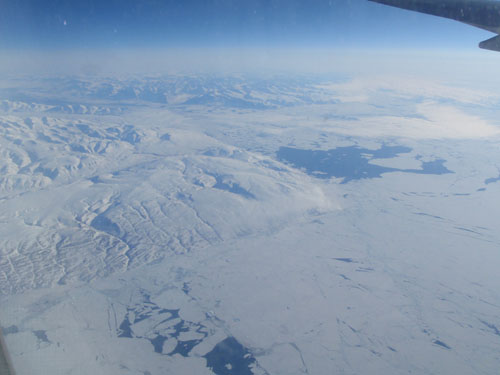
The western end of the Nuussuaq Peninsula seen from 36,000 feet courtesy of British Airways.  Note the open water possibly the result of stronger tidal flows.
 
Just to increase the level of apprehension we launched in thick fog, knowing that there were some very large icebergs nearby and we could hear the rumble as they broke up but we had no idea how far away they were.  We just trusted that we didn't stumble into one of these giants of the sea.
True to form we paddled the first 5 or 6 hours against the tide, but as we approached the western point the summits of the coastal mountains started to appear through the mist as the fog banks retreated offshore.  There were some seriously large pieces of ice which were eroding into spectacular shapes but the actual rounding of the point proved to be relatively stress free although looking at the beaches and items on the shore it was clearly an area which experiences significantly large waves.
Once around the point, Disko Island came into view and we felt that we had possible completed the crux of the paddle.  We had covered 25 nautical miles but it hadn't seemed unduly tiring.
Our campsite had superb views over the entrance to the Vaigat, our route into Disko Bay, the only slightly disconcerting thing was whilst on an evening stroll we camp across a rather large print in the sand.  There was either somebody walking around the beach wearing crampons or there was possibly a bear in the area.  As we hadn't seen any other people I went for the second option with the belief that it was an old print!  Whatever it was we didn't find out but I did wake rather more frequently during the night.

Andy in the fog, somewhere fairly close there some very large bergs
Approaching the western tip.  Note the yellow navigation mark above and to the left of the bow of the kayak.
The fog had dispersed.  It is views like this which draw us back to Greenland time after time.
  Although it was the end of July in a few places there were still some patches of snow at sea level
Nicky with a spectacular lava flow.
The backdrop to the camp site was pretty special.
The tipi is a great piece of group kit.  Although it is ideal in poor weather it really comes into its own when it is calm and the insects are active.
Is this a polar bear print?  Not that clear but enough of it was visible to cause us some concerns.
Nicky, in the late evening light, looking across the Vaigat towards Disko Island.

Wednesday, October 03, 2012

Shopping and Polar Bears: Day 5

After the gales of yesterday we packed in much calmer conditions, with the aim of getting as far as the small village of Niaqornat, as we could do with a gas canister or two.  The strong tail wind had become a reasonably strong tidal flow against us for most of the day.
Although it was a mainly overcast sky we caught some glimpses of dramatic mountain scenery to our left and some beautiful bergs to our right, There was always something to distract us as we pushed against the tide for several hours.
Eventually late afternoon we rounded the headland and the village of Niaqornat came into view.  With only 58 inhabitants in 2010, it could hardly be described as a thriving metropolis.  On landing one of the local residents, out walking his young daughter wandered over for a chat.  A very humbling experience as English was clearly at least his third language.  The shop was clearly shut but a quick call from our new friend and the shop manager wandered down to open up, that's what I call service.  He even had the courtesy to point out all of the items which were on special offer, so we left with significant quantities of chocolate biscuits.  
Heading west, initially under large cliffs followed by a low lying delta we eventually landed on a black sand beach before erecting the tents on a large glacial feature.  As would be expected close to such a large delta the insects were fairly demanding and so for the first night on the trip we had to put up the tipi, to provide some respite.
With another 21 nautical miles under our belt we were in a excellent position for rounding the western end of the peninsula, an area which everybody we had spoken to had warned us about, strong winds, rough water etc.  We hoped that the following day these warnings would be proved wrong.
 There was a beautiful quality to the light, which enhanced the icebergs.  There was very little small ice but plenty of larger bergs.
 Niaqornat, the most westerly village on the peninsula.  We just hoped that the shop was open.
 All the facilities of a modern village.  A shop (red building) and racks for drying polar bear skins!
The contrast between the new and the old.  Nicky using the superb phone signal to check on the family whilst behind 2 polar bears which were shot during the spring are stretched over the frames.  We just hoped that we were not going to encounter any of the live variety.
We decided that this huge feature was a kame terrace, a fluvio-glacial feature.  We were really excited with our background in geography.  Its at times like this that you realize why Geography is the most important subject on the curriculum.  We were actually camped on the feature but closer to the sea.
As we secured the kayaks for the evening the fog descended.   A indicator for what lay ahead tomorrow.

Saturday, February 11, 2012

Arctic Sea Kayaking

I have been slowly going through my slide collection and scanning in a few of the more memorable sea kayaking shots and have put together this group of pictures of one of my first sea kayaking trips when we paddled the length of the west coast of Spitsbergen over a period of 2 months.
We encountered a wide range of conditions and almost no other people.  It was a particularly bad summer weather wise, when we arrived at the end of June the sea was still frozen and by the end of August we were pinned in the tents in a 36 hour blizzard, the first of the impending winter.
In contrast to a lot of trips that you read about today we were relatively young, nobody was over 30 years old and I suppose the average was 25. 
It was also ground breaking in a number of ways, for example, we were as far as we were aware the first sea kayak expedition to use drysuits, they had just become available because of developments in wind surfing.
There is no escaping that it was a harsh 650 nautical miles that we paddled and looking back at the conditions we encountered it is hard to believe that things have changed so dramatically that some companies will take relative novices paddling in these waters.
It was almost the golden time of sea kayaking expeditions, with groups of paddlers heading off into distant waters, returning home to write the inevitable expedition report and give a lecture at the Canoe Exhibitions at Crystal Palace the following February.
Heading out from Longyearbyen on the first day, we were half way across a 15nm open crossing when we found that the sea was frozen.  A lengthy detour was required to make safe landfall on the northern side of the fjord.  It really was a baptism by fire.
Campsite on the first night. The winter snow drifts were still banked along the shore, making landing difficult.  We spent the evening familiarizing ourselves with the rifles which we were carrying with us in case of encounters with polar bears. 

An evening walk.  Dave, in the green jacket, has his rifle at the ready.  It was necessary to carry firearms wherever we went.
A very bleak campsite close to the Torrellbreen glacier.  Apart from out tents the scene as almost completely devoid of colour.  I remember feeling that this was a very bleak spot!
Another typical summer campsite.  We had sewn extra material to the flysheets so that they could be weighted down with stones.  It was often difficult to get pegs into the ground so we would tie the guy lines to drift wood or as in this picture, whale vertebrae.
We experienced some extended periods of poor weather, the air temperature was hovering about 0 degrees and the sea was often full of ice.  We were stuck on this beach for 3 days. 
Being stuck on beaches did allow a certain degree of creativity with the cooking.  This is instant whip being encouraged to solidify using the local ice.
The major concern for us was the possibility of an encounter with a polar bear.  We took full precautions including rifles in each tent plus alarms around the tents.  This bear (Apologies for the quality of the photo but I was still in my sleeping bag and trying to grab a rifle, as well as take a picture) had been swimming past and had come out of the sea to investigate what these strange shapes were on the beach. 
This is not sensible but we were young and foolish.
Often we would try to stay on the water for most of the day as landing was frequently very cold and once ashore we would need to have the tents up.  This wasn't ideal picnic territory.
 Just finishing our circumnavigation of Amsterdamoya.  We were just a few miles short of 80 degrees north and were starting to head back south.  At this point we hadn't seen another human being for over 2 weeks and it would be another week before we came across some Russian scientists.  In 1983 tourism had not taken off in this part of the world.
 Pete Scott and myself in front of one of the many glaciers, we had just had a very close and memorable encounter with some beluga whales.
 These paddlers (just visible) are too close to the ice front and we quickly moved away when some fairly large bits calved off.
Even on rest days we would get out and explore this pristine environment.  This was heading up one of the glaciers towards the main ice cap.

Great days, we spent two months wandering around this stunning archipelago, encountered almost no human beings and had just a superb time.