Showing posts with label Paternosters. Show all posts

Saturday, August 29, 2015

Paternosters Again

It has been a while so I posted on the site, the aim of a photograph everyday, went out the window due to changing personal circumstances, but it is probably an opportune time to start to post again.
Today's paddle was to the Paternosters, a reef off the north west coast of Jersey, which is rarely visited by by other boat owners, as landing would be almost impossible.
On today's large spring tide there was a significant amount of exposed rock but Tuesday mornings tide is another 0.6 metre lower, with an 03:27 low water,  I think its true to say though nobody will be on the reef to witness it how much more is exposed.
For us though, it was a great couple of hours on the water.
Nicky arriving at the Paternosters.  Heading west from Bonne Nuit we made full use of the ebbing spring tide, most of the time we were averaging about 6 knots.
 Looking back towards the north west corner of Jersey.  Standing here is probably one of the most isolated locations in the Baliwick of Jersey
 A merry band of paddlers.  For a couple of the group it was their first visit to this reef off the north coast of Jersey.
 Looking north towards Sark, an excellent paddling destination in its own right.
 Leaving the reef towards the north coast of Jersey
This isn't an image to show that industry occurs around the coast of but rather the scene of environmental success.  In the sheds of the quarry a pair of chough's bred, for the first time in Jersey for approximately 100 years.  Sadly we didn't see them today.

Monday, October 27, 2014

A Paternoster Sunday

The Paternoster's is a wild reef nearly 3 miles off the north coast of Jersey which is always an interesting place to visit.  Sunday morning's forecast couldn't have been more co-operative with a light southerly breeze to blow us out and then dropping off, with the sun coming out.
It was a slightly longer Sunday morning paddle for the Jersey Canoe Club than usual and it did involve taking sandwiches but it was well worth the effort.  It is strange that we were only out for 5 hours in total but after a visit to the Paternoster's you always feel as if you have had a break from the island.
 The Paternosters are just visible, with Sark on the horizon beyond
 Nicky and Kate leaving the north coast.  Sorel lighthouse is just visible on the headland behind the kayaks.
 Just approaching Great Rock from the north, landing would probably have been impossible an hour earlier due to the swell but the ebbing tide had produced some relatively sheltered areas in the reef.
 Looking south west from the summit of Great Rock.  Grosnez is the obvious headland behind
 The view north.  Sark is visible on the horizon.  What a delightful paddle we had back from Sark earlier in the summer.
Paul crossing one of the tidal flows, which contribute to making paddling in this area so entertaining.

Saturday, August 09, 2014

How far have I paddled?

Over the years I have come in for some ridicule as I have kept a kayaking log book. My first entry was in January 1979 and since that date I have made a record of every time that I have been in a canoe or a kayak.  Sometimes it might just be a brief note whilst at other times it might be a comprehensive record of where we parked the car, what the launch was like, any wildlife seen etc.  Due to the fact that I have kept the log book going for so long it has now become almost impossible to stop.
Earlier this year I was wondering to myself as to whether I paddled the equivalent of the circumference of the earth at the equator?  First of all how far is it around the equator.  Plenty of places will give you the distance in kilometres and statute miles, it was only after a bit of searching that I found the answer in nautical miles, it is 21639nm.  My log book records have always been in nautical miles so this was an important figure to find.
I then sat down with the log books and over a couple of hours completed a table. There were 5 columns, standing for year, sea kayak, sit on top, canoe/general purpose and total.  I passed the magical distance on the 19th May 2012 whilst on a trip out to the Paternosters.
So if you don't already keep a log book think about starting keeping a record of your paddling experiences, in a few years time it will make interesting reading.  I don't have a log book from 1969 to 1979 sadly, as there could be some interesting reading about a number of sea kayaking adventures, including being pulled of the water by Tito's police in the former Yugoslavia, as we naively thought it was alright to paddle on the sea in communist countries.

 The oldest picture I have scanned in.  The first trip to the Ecrehous, August Bank Holiday Sunday 1974.  Is it really 40 years since I first paddled out to the Ecrehous.  Possibly the best one day paddle anywhere.  This was probably the first ever organized paddle by the Jersey Canoe Club, which we had just formed.  This was 5 years before I started keeping a log book but it was a pretty memorable day.
A few months after I started keeping a log book.  An evening surf session in May 1979 at St Brelade's.  We were so proud of our KW7's.  So versatile, one day we would be rock hopping the next heading out to an offshore reef.

 One advantage of keeping a log book is that you are able to track your memorable paddles.  This is dawn on the morning of my 150th paddle to the Ecrehous, we are packing away before returning to Jersey.
The day that I passed the equivalent of the circumnavigation of the earth.  Getting ready to leave the Paternosters.

Wednesday, October 10, 2012

Derek Hutchinson

Sadly Derek Hutchinson passed away today, a truly remarkable character who must be able to lay claim to being the "Father of Modern Sea Kayaking".  I remember purchasing my copy of "Sea Canoeing" as soon as it came out in 1976 and meeting Derek for the first time in 1979 when he had just returned from the Aleutians.  He stayed with us on many occasions in Jersey and it was always entertaining.
At one Jersey Sea Kayaking Symposium, the speaker forgot to turn, up Derek stepped in with a spontaneous talk of his North Sea crossing and without any visual aids produced a spell binding talk.  You could have heard a pin drop in the crowded room.
In the photograph below Derek, in the kayak, is offering advice in his unique style about the virtues of cliff jumping, as Barry Howell flies through the air at the Paternosters.
A great character it is impossible to measure the impact he has had on modern sea kayaking. I remember fondly an afternoon, in the 1990's when Derek and myself sat in the warm autumn sunshine on the deck of the ferry between Port Angeles and Victoria just chatting about sea kayaking. Great memories.

Sunday, May 20, 2012

The plan had been to load the sea kayaks onto the RIB on Saturday morning, head up to Sark,  be dropped off and then picked up on the Sunday evening, allowing two days of kayaking around our sister isle.  Unfortunately the wind forecast for Sunday afternoon was too high for the boat to operate, so on Saturday morning at 06.30 an alternative plan was quickly hatched.  A visit to the Paternosters, off the north coast of Jersey.
 We headed east from Greve de Lecq, exploring a number of the coastal features, including Devil's Hole. It is not that often that it is possible to paddle as far back into the cave but there was no swell at all.
 Once the tide drops at the Paternosters there is a delightful lagoon which offers sheltered landing, although today sea conditions were such that it would have been possible to land just about anywhere.
 Considering it is the middle of May it was a pretty grey day.  Contrast this with our visit in February.  It is hard to believe so many of the group selected dry suits to paddle in.
 Heading out of the lagoon, about an hour before low water, hoping for some reasonably light tidal streams.
 The tide was already moving from left to right, it is just discernable behind Gary and Pete.  It was nothing that a bit of ferry gliding wouldn't compensate for.
 As there was no swell we took advantage to explore the western margins of the reef.  For some of the kayakers, although they had visited the reef many times before this was the first time that conditions had allowed them to paddle through some of the channels.
 Leaving the reef for the north coast of Jersey,  it doesn't get much flatter than this.
 Approaching Greve de Lecq.
 Nicky checking the distance on her GPS, it was just under 8 nautical miles.  Jersey's beaches shouldn't look this bleak in May.

So we didn't make Sark, that is still to be re-arranged, but we did make the most of our disappointment.

Saturday, February 04, 2012

A Gneiss Paddle

Just under 3 miles north of Greve de Lecq lie the Paternosters, a reef which for many sea kayakers offers their first opportunity for heading offshore.  Although the tidal streams can run with surprising speed towards low water the crossing can be reasonably direct and straightforward, which is what we had planned for today.  Leaving just before low water slack and hopefully taking a fairly direct route.
At high water only four summits are left protruding from the swirling waters but at low tide an extensive reef is uncovered.  Great Rock, which is ten metres high and Sharp Rock, four metres high, are the largest rocks and are situated in the middle of the bank.  Our plan was to have a drink and some food on the north side of Great Rock in the weak winter sunshine, taking advantage of a lull in the wind before the possible gales arrived in early evening.
The origin of their name is said to be due to a ship on its way to Sark, in the 16th century, striking one of the rocks and a number of women and children drowning.  As a result it became common practice for fishermen to say a Pater Noster or a prayer as they passed close to the reef.  Although they have two names it is the Paternosters that has been accepted into everyday use.  A more recent ship wreck occurred on the 16th September 1961.  A Dutch owned vessel, the Heron was en route to Portsmouth when it sank, with the loss of 3 lives.  The wreck lies in about 30 metres of water to the south of the reef.

On the beach at Greve de Lecq, ready for departure.  The Paternoster's are visible on the horizon, just over 2.5NM offshore.
 Heading out from Greve de Lecq, the Pats visible on the horizon.  This is one of a number of photos taken using a GoPro.  I used on the setting for one photograph every minute, I kept a few with most in the Trash.
 John the "Commodore" of the Jersey Canoe Club approaching the Pats.  Although it was an impromptu paddle we still had 11 members turn up.  Not bad for a morning when the temperature was below freezing.
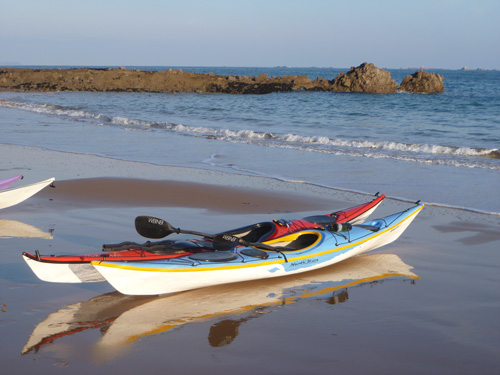
 Even closer to the reef.  The white kayak is a late 1970's Anas Acuta which was virtually buried for years but about 18 months ago was dug up, it has been refurbished and is as good as new.
Ideal paddling conditions for the first weekend in February.
The classic approach to the Paternosters, a ferry glide.  The tide was just starting to run from right to left. A well known jump is from near the summit of the main rock.  Conditions were a bit too cold for such activity today.
 I explored the north side of the reef and then threaded my way through some shallow channels.  Other members of the group are visible just above the bow of my kayak.
Looking down from the highest point of the reef.  The rocks are gneiss which is metamorphosed granite, a type of rock which isn't seen anywhere on the main island of Jersey.
 We are about to jump on the tide towards Plemont headland.  Although it was only a neap tide we averaged 5 knots on the 2NM crossing to Plemont headland.
 From this distance it was difficult to distinguish most of the details of the Jersey coastline.
Looking along the coast.  Mainly in the shade but with a few glimpses of the sun through some of the gaps in the cliff top.
Nicky heading along the coast.  We had seen numerous Razorbills along this section of the coast plus some very inquisitive Fulmars.
Landing back at Greve de Lecq, a great morning out followed by a well earned pint in front of the fire at the Moulin de Lecq.

Tuesday, November 08, 2011

Sea Caves and Cliff Jumping


 Jumping into warm water allows modification in the paddlers equipment.  Each stretch of coast is viewed by the kayaker as a potential jumping site.

This has been a difficult post to write, not from a literary perspective but rather from a safety point of view.
  A number of people may find some of the ideas somewhat controversial.  The idea of encouraging people to jump off cliffs into the sea must cause numerous Health and Safety inspectors to turn in their graves.  We need to be realistic though, generations of young people have flung themselves from bridges, cliffs etc, all in the pursuit of pleasure..  It seems to be more sensible to offer suggestions on how to jump in safety as opposed to discouraging people and perhaps forcing them to indulge in this pastime without any guidance.
As we are all aware the sea kayak is the ideal craft for the minute exploration of the indentations of the coast line.
  The small nooks and crannies, often with steep sides offer excellent opportunities for climbing out of the kayaks, scrambling over the rocks and jumping back into the water before paddling on.  This can be one of the great pleasures of paddling but to enjoy it safely requires some knowledge and technique.  These are ideally acquired before heading out onto the open ocean.
 This is an ideal practice jump.  Not too high but clearly over hanging so if there is a mistake on take off the jumper will still hit the water.

Probably the key to safe jumping is confidence and this is best acquired in a controlled environment.  My ideal choice is a small harbour with a good set of steps.  The depth of water is normally clearly indicated and the sea bed will, for obvious reasons, usually be free of obstacles.  It is vital to check for any local laws and to keep clear of any boats which are operating in the area.  The flat harbour wall provides a solid base for the feet prior to jumping.  Select an area in which you want to land, at least a metre away from the wall.  Place one foot in front of the other and then push off confidently.  When flying through the air use your arms to steady yourself, making sure that you pull them into your sides just prior to hitting the water.
Ideally it should be a short swim back to the steps and you are ready for another go.
  There are a number of harbour walls, nearby, which offer jumps of differing heights, so that as experience is gained and confidence increases it is possible to increase the height of the jump.  In areas with large tidal ranges it is possible to vary the height by using the same location but visiting at different phases in the tidal sequence.
Although this looks like a good jumping location, it is not a sensible place to explore.  It was a reasonably difficult climb to the top of the stack with a couple of moves we would not have wanted to repeat.

Harbour walls are just the beginning; the excitement comes from paddling along secluded sections of coasts and identifying areas to explore which are beyond the scope of most other people.  An ideal location would have somewhere easy to climb out of the kayak, although at times it is easier to climb out of the kayak in deep water then swim ashore.  The water should be clear so that any potential hazards are easy to identify from above.  The jumping spot should be flat and reasonably large in size.  In addition the walls should be steep, ideally overhanging so that there is no possibility of hitting the rocks if a slip should occur or if the jump isn’t as positive as it should be.
Another good jumping spot, this is off the north coast of Milos.  Jumping over the entrance to the arch ensures safety.

Start off with simple jumps in protected inlets in the company of other experienced coastal explorers before attempting more demanding jumps.  There are some important points to consider.  It is perfectly acceptable to say no to a jump and do not give grief to people who are unwilling to attempt certain jumps.  This is an activity which is meant to be enjoyable and  fun.
Always have the right equipment; shoes are essential and protective clothing for the arms and legs, such as a wet suit.  This is to help protect against barnacle rash, a painful affliction which occurs when skin comes into contact with barnacle covered rocks.  Many people prefer to keep their buoyancy aid on when jumping but it is important to hold it tight when entering the water to prevent it riding up.  It does offer extra protection if collisions with rocks are possible.  If a swell arrives when you are in the water then the safest option is to remain in deep water, where it is unlikely for the waves to break until the waves die down.
Once you have experienced the thrill of exploring the coastline and jumping into the sea it is unlikely that you will ever view the cliffs and gullies in the same way again.  Each rocky knoll becomes a potential site of adventure and challenge with weather and isolation doing very little to dampen enthusiasm.
The sea kayak gives access to new areas.  This is a well known jump off the main rock of the Paternosters, off the north coast of Jersey.  Depending upon the state of the tide the jump can be up to 55 feet high.
 
 A historic photograph to illustrate that cliff jumping isn't a new activity.  The paddler is Derek Hutchinson at one of the Jersey Canoe Club Sea Kayaking Symposiums in the early 1990's.  The intrepid jumper is Barry Howell.

Thursday, September 08, 2011

The Paternosters

For many sea kayakers their first open crossing can be quite a daunting prospecting, cutting the tie with the shore and heading away from the security of the land requires a different approach to when you are just paddling parallel to the shore.
For many Jersey sea paddlers their first visit offshore is to the Paternosters reef which is nearly 3 miles off the north coast of Jersey.  3 miles isn't that far but when combined with cross tides up to 5 knots an the exposure to the Atlantic swell it becomes a bit more challenging than your average paddle.
At high water landing can be a problem, if not impossible, if there is any swell but as the tide drops a number of sheltered lagoons are uncovered which allow access to the reef.
I first paddled to the Paternosters in early 1979 and every year since I have visited on a number of occasions but have never encountered any other people on the reef, it really is the ideal place to get away from the crowds in Jersey.

Peter Wrigglesworth arriving at the Paternoster's after a crossing from Greve de Lecq.  The rock is gneiss, a metamorphosed granite which isn't found anywhere else in Jersey.

 One of the great aspects of the Paternosters is that it is the site of one of the best jumps in the Channel Islands.  John Richardson and myself are taking full advantage of the warm water.
 A few sea kayaks on the reef on a bitterly cold January day.  There was ice on the beach when we left and it was still there when we arrived back a few hours later.
 At low water rocks and boulders are uncovered with a few isolated sheltered lagoons.  At high water just a few isolated heads are exposed generally catching the full force of the North Atlantic swell.
 Looking back towards the north west corner of Jersey.  The island looks like distant in these conditions.
 Heading south towards Greve de Lecq, on sunny days it is always difficult to identify specific locations due to the angle of the sun.