Showing posts with label spring tide. Show all posts

Thursday, August 07, 2014

Ecrehous Day Trip

The neap tide, today, meant that timing for departure wasn't as crucial on some other days but we were still on the water promptly just before 09.30.  The Ecrehous is one of the great, if not the greatest, one day sea kayaking trip.  
Just over 5 nautical miles north east of Jersey it is necessary to allow for tidal drift as on springs the tidal streams can reach over 5 knots but as you start to enter the reef it soon becomes apparent that you have arrived somewhere really special.
Today was no different.  If you are ever in Jersey with a sea kayak, a visit to this special place should be high on your list of priorities.
 
The view across the pool towards Jersey, it wasn't as busy as on some other summer days.  Whilst sitting on the bench having lunch a grey seal spent some time swimming around in the water below us.
Looking north across the reef.  In a few hours time all of the rocks would be submerged by the rising tide, next Tuesday would be even more interesting as the tides are so much larger.   Today's high water was 27.9 feet, in 5 days time it is 39.6 feet!
Looking along the shingle bank its hard to believe that on Spring's standing waves develop as the tide runs across the bank.
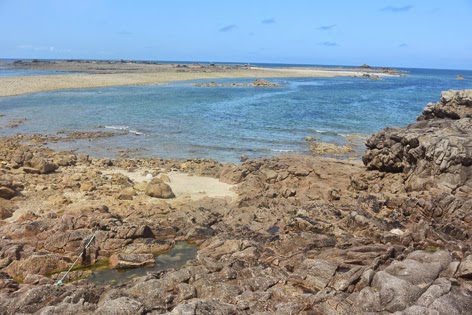
If time allows when visiting the Ecrehous it is always worth walking north, partly to escape the crowds but more importantly to view the dramatic seascape.
 Looking across towards the Normandy peninsula of France.  The clouds defined the edge of the land.
 Nicky paddling past one of the huts as we paddled north to catch the last of the south flowing flood tide.
 The edge of the reef, it was right hand sweep strokes to line up for a 5 mile crossing.
 Visibility was pretty good today so Jersey was clearly visible as soon as we left the Ecrehous. After about 1 nautical mile we had several groups of bottle nose dolphins pass in front.  They seemed pretty focused on heading west so they didn't stay and investigate.

Sunday, February 02, 2014

West coast damage

For the second time this year a damaging storm and large swell has coincided with a spring tide, creating the potential for significant damage and disruption.  Fortunately the pressure wasn't too low, about 1006 mb, so although it had an impact on the height of the tide it was too significant.
All around Jersey the islanders have been counting the cost of the late and early morning battering including on the west coast where the Splash Surf Centre has been almost destroyed.  At 10.00 last night we were rushing to remove all of the boards, wet suits, stock etc as the waves pounded the sea wall.  Amazingly the whole building was moved by the power of the waves and the rear wall ripped off.
First light today, when the full extent of the damage could be seen also coincided with a 12 metre high water, so water was again pouring over the sea wall, some of the waves must have been shooting nearly 50 feet in the air and with a particularly powerful wave we witnessed the building move on its foundations.
Fortunately nobody has been injured and it proved possible to save virtually all of the equipment.  Amazing power of the sea.

 Looking towards the Splash Surf Centre at first light this morning.  The side of the building is missing.
 I think the wedged board is the only thing keeping the roof in place.  Emptying this at 10.30 last night was quite a challenge but people turned up and saved virtually all of the equipment.
 Looking south towards El Tico, the car park has turned into a lake.
 Every now and again a bigger set would roll in.
 Dave Ferguson from the Jersey Evening Post, perhaps going beyond the call of duty as a photographer
 This was a split second before a large wave swept over us.  The dark bits are seaweed contained within the wave.  The posts in the car are just visible to the lower left.
Looking north towards the White House as another wall of water crashes over the sea defenses. Just beyond the White House there was some significant damage to the sea wall. 

Tuesday, September 27, 2011

Low Tide Exploration

On one of the warmest days of the year, combined with one of the largest tides a sea kayaking trip should have been the order of the day but work commitments got in the way.  But what better alternative than exploring Jersey's unique environment, off the south east corner of the Island.
As the spring tide retreats a unique landscape is revealed, a mixture of shingle, sand, rocks etc are exposed for up to two miles from the shore.  The importance of this area is recognized by the fact that it was the first Ramsar site to be designated in Jersey, in November 2000.
A favourite destination for low water fishermen, I was surprised how few other people were in the area, considering the weather.  A great way to spend the last Tuesday afternoon in September 2011. 
 Looking north towards Gorey and its spectacular castle just after we left the Seymour Slip.
 Approaching Seymour Tower.  Built in 1782, it was named after General Seymour Conway, the Governor of the Island.
 Looking south east from the Tower there was still a considerable distance to go to the waters edge.  Unfortunately we were too late leaving to head much further out.
The shadow of the tower points towards the east coast of the Island.
 The rocks in the distance are the Petite and Grande Anquette.  An interesting sea kayaking trip to an isolated part of Jersey's coastal waters.
Looking west along the south coast of Jersey, exposed rocks as far as the eye can see.
 Seymour Tower viewed from the south.  The concrete additions on top are as a result of the German occupation of the Island.
 The dried seaweed indicates the direction of the tidal flow as the banks dried.
 One of the larger sand banks.
 We paid a visit to Little Seymour, as we headed back towards Jersey.
This is an area which is not without economic worth.  These are oyster beds but there are also significant areas of mussels.

Sunday, September 25, 2011

Spring Tides This Week

This week sees some of the largest tides of the year, with significant amounts of water moving around the island.  Wednesday in particular promises to be pretty entertaining for both the casual observer and sea kayaker.
The basic facts are as follows:
High Water:  19.57  39.3 feet  12 metres
Low Water:   02.45   1.7 feet  0.5 metres
This translates to a tidal range of 37.6 feet or 11.5 metres, which is pretty substantial.
Using the 12ths rule this means that in the 3rd and 4th hours of the tidal sequence there is 1.89 inches of vertical movement every minute for the whole two hours, the water will just be flowing up the beach with not inconsiderable speed, an amazing sight to see.
I am certain that many locals will be heading out low water fishing but I am sure that a number of sea kayakers, myself included will be heading for the tidal races, particularly Tour de Rozel.
 High water at St Brelade's Bay, it is normally possible to walk to the pier along the beach.  In some places off the south east corner of the island at low water the sea will have retreated nearly 2 miles, exposing a unique littoral environment.
If there is any swell there is the potential for significant flooding along the south coast and at St Ouens, fortunately Magic Seaweed is predicting 2 feet or less of swell for Monday.
What there will be plenty of opportunity for is playing in the tidal races, particularly off the north coast.  Light winds and high temperatures can only enhance the paddling possibilities.


Tuesday, March 22, 2011

A Very Big Tide

Another weekend with light winds meant a possible visit to the Ecrehous by sea kayak but as it was one of the highest tides of the year an overnight stay was favourite. In the channel between Jersey and the reef the tidal streams reach speeds of over 5 knots, unfortunately not in the direction we wanted to head.
It was important to take advantage of the short tidal window for the crossing and to be prepared for the change in direction of the tidal flow. The speed at which it picked up was surprising so the last couple of miles into the reef were slightly more challenging than anticipated. After a mile of ferry gliding across overfalls in the dark we were pleased to touch dry land, although as it was high water there wasn't much of it left.
We had the reef to ourselves that night which was unusual as there are normally a number of other residents. A couple of beers later and a warm meal and we were set up for the night.

Nicky heading towards on the Saturday afternoon. Some barely visible white dots just in front of the kayak are all that could be seen of the main reef. Little did we realize that it would be dark by the time we arrived. The north going tide was running particularly fast and due to the size of the tide there were virtually no rocks uncovered which it was possible to shelter behind.The Sunday morning high tide left very little room for the kayaks but the high pressure depressed the level it reached. We did tie the kayaks to the building just in case a swell developed overnight.
A couple of hours later the sun had burnt off the cloud and the falling tide had exposed the shingle bank. At high water the tide runs with considerable speed from left to right, creating some interesting standing waves.
The tide runs with surprising speed remarkably close to the rocks. This would not be a good place to slip on the rocks and fall into the water. It would be far too powerful to swim against.
A small pod of Bottle Nosed Dolphins headed south through the sound but unfortunately an erratic and inconsiderate French power boat driver attempted to run over them and they disappeared without a trace.
A small group of Turnstones, there was an interesting variety of birds present including some wintering Brent Geese and Red Breasted Mergansers. Possibly the most unusual species were two crows which arrived from France and headed towards Jersey, they were the first ones I had seen after over 30 years of paddling to the reef.
A small section of the huts on the western side of the island. They are well maintained by their owners and the early spring sunshine portrayed them in their best light.
This was our comfortable base for the night and it even came with its own washing line.
We decided to launch on the French side of the reef, the carry on the western side of the reef was several hundred metres longer, not that appealing a prospect with loaded sea kayaks.
Nicky paddling past Marmotier. Although we had the reef to ourselves overnight there were a number of visitors on the Sunday morning, mainly from the ports on the Normandy coast.
Pete and Alex in amongst to rocks to the south west of the reef on our way back to Jersey. By crossing at low water as opposed to high tide it is possible to reduce the distance on open water by over a mile. The low water slack is much easier to use for the crossing, it took 2 hours 40 minutes going out on the Saturday evening and only 1 hour 10 minutes heading back on the Sunday and it was far more relaxing.

Monday, March 21, 2011

The Journey to Work

The highest tide of the year provided a beautiful backdrop to the drive to work this morning. The high pressure prevented the water rising as far as predicted but it was still fairly spectacular. For those who have been to Jersey I hope that it stirs favourable memories and if you haven't remember we are just a short flight away.

Looking towards St Aubins harbour
Luckily there was no swell otherwise it would have breached the coastal defences, flooding the cycle path and nearby roads.
Looking across St Aubins Bay towards Elizabeth Castle, which dominates the entrance to St Helier harbour.
The water in St Helier harbour provides a perfect reflection.
The entrance to St Helier harbour. If it had been low pressure rather high it is possible that the water could have covered the piers. The island looked stunning in the spring sunshine but the size of the tide was the icing on the cake. Who could fail to have a good day at work after seeing scenes like these, though naturally I would rather have been on the water.

Thursday, September 09, 2010

Tour de Rozel

Today was one of the largest tides of the year, creating ideal conditions for sea kayaking so I headed to Tour de Rozel in my new Nordkapp LV.
Low water was 14.28 0.5M 1.8 feet
High water was 20.04 12.1 M 39.7 feet
This produced a tidal range of 11.6 M or 37.9 feet. This was a huge amount of water to move in 5 hours 36 minutes and it was clear that there would be plenty of excitement off the major headlands.
Tour de Rozel is in the north east of the island and in the 2 hours we spent there we were not disappointed. Fast moving tidal streams and complicated wave patterns produced aching shoulders and a memorable afternoon.


Chester heading back to the relative calm of the eddy.
Andy enjoying the speed of his Nordkapp
Pete crossing the inshore stream with the Red Arrows overhead.
This is what sea kayaking is all about! The Ecrehous are visible behind.