Showing posts with label Hanois. Show all posts

Thursday, December 11, 2014

Memories of warmer days

As the rain beats down on the windows and the wind starts to increase towards its predicted 55 knots is not too hard for thoughts to start to drift back towards the warmer days of summer.  Good memories and its only 4 days until the evenings to start to pull out.
 Agnes heading along the west coast of Ile de Brehat.  Waterproofs still on but it was the first weekend in May so still plenty of time to warm up.
 The west coast of Comino.  Mediterranean paddling is always a treat.
 Dawn in Baja.  The classic Mexican campsite.  The start of another great day in the Sea of Cortez
 Fascinating geology
 Always a favourite, the Ecrehous never fail to impress but it wasn't quite as pleasant a couple of weeks ago.
 Passing Gorselands on the south coast of Jersey.  A slightly different view of the cliffs to that a couple of winters ago
 The Hanois, off south west Guernsey, I don't think I had ever paddled out there when it was this calm.
 Approaching Jethou, off the east coast of Guernsey.  I think this day was probably my favourite Channel Island paddle of the year.
Sark never fails to deliver.  A pleasant way to spend a weekend in July.

Tuesday, September 09, 2014

A swim to the Hanois

Off the south west corner of Guernsey is one of the classic lighthouses, the Hanois. We paddled out to the light in June this year, but sitting at Cobo last Saturday evening Brian Aplin explained that he had planned to swim from Lihou, out to the Hanois the following morning.  The aim was to use the southerly tidal stream to speed things along although care was needed not to be swept past the reef.
Launching from the causeway across to Lihou was probably the most challenging part of the day, the tide was dropping at quite a rate.  We joined up with Brian off the north west corner of Lihoumel and very quickly felt the impact of the tide.  Accelerating through the reefs but heading towards the Lighthouse.
Brian swam with just a couple of breaks to take on extra liquids.  On my GPS I measured the course as 2.18 nautical miles, taking him 1 hour 40 minutes to cover the distance.
I towed Brian's Nordkapp but when we arrived at the lighthouse there wasn't an easy option for him because we paddled a further 12 miles to St Peter Port.
 Joining up with Brian off the north west corner of Lihou.  He is just to the left of the closest rock.  The Hanois is barely visible in the distance.
Well under way.  Lihou is the large island on the horizon.  Brian swam in his crocs, they seemed ideal for this type of activity
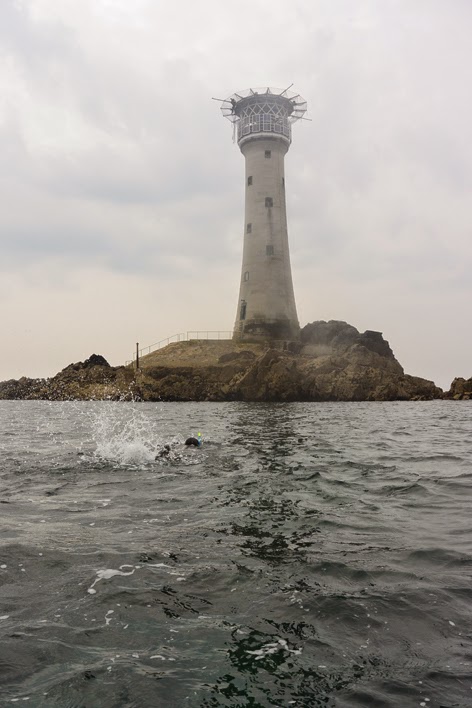
 At this point I thought there was a possibility of missing the reef as the tide was pushing us south fairly quickly.  With the benefit of knowing how to ferry glide when swimming Brian did achieve the shelter of the reef.
 Almost there.  As far as we know nobody else has completed this remarkable swim.  What  a way to spend a Sunday morning.

Thursday, July 10, 2014

A Calm Hanois

I first paddled out to the Hanois in May 1981, located off the south west corner of Guernsey it seemed like a great adventure at the time.  A few years later I was running an Advanced Sea (5 Star nowadays) in the area and we were lucky enough to be invited into the lighthouse.  In fact we were given the opportunity to stand on the helicopter landing pad.  That was an interesting experience!
Sadly those days have gone as the lighthouse was automated in 1996.  It is still a fascinating place to paddle and well worth the effort if you are visiting Guernsey.  Most years though the sea has been far too rough to approach the reef, let alone land, so it felt quite special as we wandered over and through the reef. 
Although granite from Guernsey has been exported for hundreds of years, for example Blackfriars Bridge in London was repaved with Guernsey granite in 1840, with London Bridge and the Strand following a few years later, the Hanois Lighthouse was built with granite imported from Cornwall.  The stone was dressed on the harbour in St Peter Port before being transported around to the south west corner of the island.  The work took nearly 2 years and the light was first lit on the 8th December 1862.
Since that date it has warned shipping of the dangerous reefs to be found off the west coast of Guernsey.
Hanois Lighthouse viewed from the south east.  The helicopter landing pad is clearly visible.  The last few years we haven't been able to get this close whilst on our annual Lihou visit.
There were several places to land but we selected this sheltered location on the western side of the reef where it was possible to moor the kayaks.
Lying on my back with my feet against the lighthouse gave an unusual perspective.
Paul, who had landed here a couple of days earlier decided to spend his time exploring the reef as opposed to the lighthouse.
Looking back through the reef towards Lihou, clearly visible through the gap in the rocks.
Paul was kind enough to bring some Tiderace kayaks over for people to try.  The paddle out to the Hanois was an ideal opportunity to see how they handled.

Thursday, February 23, 2012

Roches Douvres

25 nautical miles west of Corbiere lies the the reef of the Roches Douvres.  On clear nights, the white flash every 5 seconds, is visible on the horizon and it had long been an ambition to paddle out there.  It was the only part of "Channel Island" waters which I had never visited by sea kayak.  It is a long way to go though with obvious escape routes, so ideal conditions and confident partners are required.   So when tides and weather seemed to combine to make a visit possible Chris, JR and myself started planning.  It was less than 48 hours from conception to departure.
The Roches Douvres was first lit on 15th December 1868 although construction wasn't completed until August 1869.  For over 70 years it helped protected mariners operating in the area but the top of the light was blown off by the retreating Germans in August 1944.  Reconstruction wasn't completed until 1954, so my understanding is that it was the last major lighthouse to be completed in France.
It was automated in 2000, so we had the reef to ourselves on a perfect June evening.  We settled down for an enjoyable bivi prior to an early start the following morning for the return crossing to Jersey.

 Approaching the Roche Douvres in near perfect conditions.  We felt very isolated at this point.  The lighthouse is reputed to be the light which is furthest offshore from mainland Europe.  The north Brittany coast was 15 nm to the south.
 Three original Nordkapps.  Two HM's and one HS.  Classic kayaks in magnificent surroundings.
There wasn't much to explore on the reef, but we did climb to the top of the old helicopter landing pad to get a mobile phone signal.  It was French, phoning home required an international call.
We prepared for the bivi in almost perfect conditions.
We had woken to clear skies but conditions were deteriorating rapidly.  It didn't matter how fast we packed, things weren't going to improve for quite a few hours.
Visibility had dropped significantly in less than 30 minutes.  The top of the tower, at 197 feet above sea level, was fast disappearing.
I was afloat first and it quickly became apparent how limited the visibility was.  It was obvious that it wasn't going to be a relaxing 25 nm crossing.
Visibility was very limited for the first 4 hours.  All we saw was an ice cream container and a dead cormorant.  At least it meant we could continue to focus on the GPS.  For at least the first hour Ile de Brehat, in France was closer, then for the next hour it was the Hanois, off Guernsey which was closer.  Eventually Corbiere became the closest way point.  We at least felt that we were on the homeward stretch
Due to the poor visibility we called into Jersey Radio (later changed to Jersey Coast Guard) to inform of our position and to ask for advice regarding the shipping in the area.  It was a relief when they called up later to request our position as there was a Condor fast ferry in the area.  By this time the visibility had started to improve but it was still a relief to see it pass by.
A welcome sight.  Corbiere Lighthouse our final destination after over 5 hours of paddling.  As we had managed to maintain a good pace we were back in Jersey in time for lunch and a pint at the Corbiere Phare restuarant and bar.

This paddle was first put on the blog in June 2007.

Thursday, February 09, 2012

Lihou Island

Over the last few years I have come to know a particular area of the Channel Islands particularly well, Lihou, a small island off the west coast of Guernsey.  The island is now managed by the Lihou Charitable Trust, with their enthusiastic manager and local sea kayak guide, Richard Curtis.
There is so much to see on the island that I can happily spend a week out here without feeling the need to go "ashore".  For the visiting sea kayaker there is accommodation in the form of a refurbished bunk house which has been part funded by the Jersey Canoe Club

Lihou house sleeps up to 30 people with all modern facilities.  On the southern end of the house there is a great conservatory where to pass the time of the day.  The views to the Hanois are truly memorable.  From last autumn the house has been powered mainly by solar energy.
Access is across the causeway at low tide on springs.  On neap tides the island remains cut off throughout the tidal sequence.  Then the main access is via kayak.
The house viewed through the ruins of the Priory, which was founded in the 12th century.  The island has a rich and varied history for those who are prepared to do their research.  At one time it was the largest producer of iodine in the world, as a result of burning seaweed.
Crossing to the island from the west coast of Guernsey.  Even on the windiest days it is possible to find some shelter for the crossing.  Wind against tide can create some entertaining conditions in the main channel.
This was taken on an early evening paddle towards the reefs to the south west of the island.  Next landfall after the stacks is Newfoundland, with the result that there is frequently quite an entertaining swell.  Out here on my own, I felt pretty isolated. 
To the south west of Lihou lies the Hanois, a dramatic lighthouse with a challenging landing.  On this particular day we had to swim in from the kayaks offshore, not every member of the group took up the invitation.
The Hanois is a classic lighthouse although its graceful lines have been altered due to the addition of the helicopter landing pad.  As with all lighthouses it is now unmanned but I remember visits in the 1980's when we used to deliver papers and milk on Sunday mornings.

Tuesday, September 06, 2011

Les Hanois Lighthouse

This year I have been fortunate enough to visit the Hanois Reef, with its distinctive lighthouse, twice.  On following days but in contrasting weather conditions.  On the Saturday, low cloud, drizzle and steady force 5 from the south west created interesting kayaking conditions.
By the following morning the wind had dropped, the sun had come out, it was a different world
Les Hanois is built on a reef off the south west corner of Guernsey, protecting generations of seafarers from the hazardous conditions which are found in this area.
From the early 19th century it was felt that a lighthouse was needed in this area but it wasn't until early 1860 that the first stone arrived on the Island.  Cornish granite was taken to Castle Cornet, at St Peter Port, where it was worked on by craftsmen from Cornwall before being transported around Guernsey by barge.
The work was frequently interrupted by poor weather conniptions and if that was the case the builders who were living in Fort Grey, helped to build the Trinity House Cottages on the way to Pleinmont.  The light was lit for the first time on the 8th December 1862.
I remember on bleak October day in the early 1980's running and Advanced Sea Course in the area.  we left from Rocquaine Bay, with fresh milk and the papers, which were the calling card of sea kayakers in those days.  A little gift almost invariably resulted in being invited in.  Our excitement for the day was being allowed to climb out onto the helipad.  Added in 1979 it is 33 metres above the sea and standing on it, with the sea breaking over the reef below, was one of the most terrifying things that I have ever done.
Those hospitable days are long past though as the light was automated in 1996. That said any sea kayaker who is visiting Guernsey should plan to visit the Hanois, its a great couple of hours.
Looking out towards the Hanois from Pleinmont headland.  On a day when sea conditions were relatively calm.

Just off the Hanois in June this year, in conditions more reminiscent of the autumn than early summer.

Heading back towards Lihou after failing to land.  Not all of us made it back to the island upright!
Approaching the Hanois on the second day.  Conditions had improved significantly although landing was still a challenge.
It is only when looking up the lighthouse that the true beauty of the construction can be appreciated.
Although it was much calmer the easiest way to land was to swim in whilst leaving the kayaks in the care of somebody offshore.  Lihou island is just visible through the rocks behind the kayaker furthest left.
John Richardson enjoy the benefits of a salt water bath.

A visit to Les Hanois is always memorable so I am hoping for good weather next week when I am on Lihou with a school group for the week and should be able to get in a visit to the reef if conditions allow.