Saturday, February 04, 2012

A Gneiss Paddle

Just under 3 miles north of Greve de Lecq lie the Paternosters, a reef which for many sea kayakers offers their first opportunity for heading offshore.  Although the tidal streams can run with surprising speed towards low water the crossing can be reasonably direct and straightforward, which is what we had planned for today.  Leaving just before low water slack and hopefully taking a fairly direct route.
At high water only four summits are left protruding from the swirling waters but at low tide an extensive reef is uncovered.  Great Rock, which is ten metres high and Sharp Rock, four metres high, are the largest rocks and are situated in the middle of the bank.  Our plan was to have a drink and some food on the north side of Great Rock in the weak winter sunshine, taking advantage of a lull in the wind before the possible gales arrived in early evening.
The origin of their name is said to be due to a ship on its way to Sark, in the 16th century, striking one of the rocks and a number of women and children drowning.  As a result it became common practice for fishermen to say a Pater Noster or a prayer as they passed close to the reef.  Although they have two names it is the Paternosters that has been accepted into everyday use.  A more recent ship wreck occurred on the 16th September 1961.  A Dutch owned vessel, the Heron was en route to Portsmouth when it sank, with the loss of 3 lives.  The wreck lies in about 30 metres of water to the south of the reef.
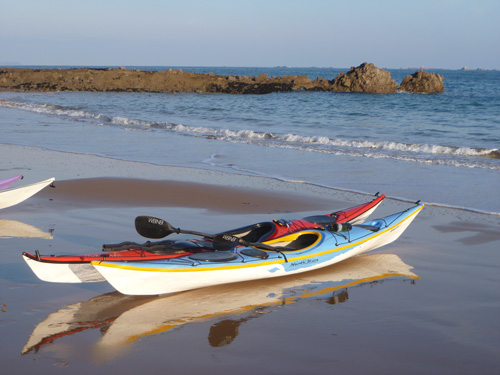
On the beach at Greve de Lecq, ready for departure.  The Paternoster's are visible on the horizon, just over 2.5NM offshore.
 Heading out from Greve de Lecq, the Pats visible on the horizon.  This is one of a number of photos taken using a GoPro.  I used on the setting for one photograph every minute, I kept a few with most in the Trash.
 John the "Commodore" of the Jersey Canoe Club approaching the Pats.  Although it was an impromptu paddle we still had 11 members turn up.  Not bad for a morning when the temperature was below freezing.
 Even closer to the reef.  The white kayak is a late 1970's Anas Acuta which was virtually buried for years but about 18 months ago was dug up, it has been refurbished and is as good as new.
Ideal paddling conditions for the first weekend in February.
The classic approach to the Paternosters, a ferry glide.  The tide was just starting to run from right to left. A well known jump is from near the summit of the main rock.  Conditions were a bit too cold for such activity today.
 I explored the north side of the reef and then threaded my way through some shallow channels.  Other members of the group are visible just above the bow of my kayak.
Looking down from the highest point of the reef.  The rocks are gneiss which is metamorphosed granite, a type of rock which isn't seen anywhere on the main island of Jersey.
 We are about to jump on the tide towards Plemont headland.  Although it was only a neap tide we averaged 5 knots on the 2NM crossing to Plemont headland.
 From this distance it was difficult to distinguish most of the details of the Jersey coastline.
Looking along the coast.  Mainly in the shade but with a few glimpses of the sun through some of the gaps in the cliff top.
Nicky heading along the coast.  We had seen numerous Razorbills along this section of the coast plus some very inquisitive Fulmars.
Landing back at Greve de Lecq, a great morning out followed by a well earned pint in front of the fire at the Moulin de Lecq.

Friday, February 03, 2012

A Quick Reminder

As we hope that winter is perhaps having her last attempt to keep us off the water many paddlers thoughts are turning towards the warmer months of summer.  I have received numerous e mails about potential sea kayaking in the Channel Islands, which I am always prepared answer but if you are interested in paddling in Britain's south sea islands then why not have a look at the Sea Kayaking Guide which is available for the Kindle and other e readers from Amazon.
Comments will be appreciated.
We look forward to seeing you in the Channel Islands in 2012.

Thursday, February 02, 2012

More Capital Paddling

The second day of our kayaking in the heart of London required a much earlier start as we were heading down stream on the last of the ebb tide.  It was a bright sunny morning after a wild night, wind wise, at the Shadwell Basin.  We were carried past Canary Wharf and Greenwich until we were just passed the O2, by now the tide had turned and it was time to head back up stream.
We landed in Greenwich, quite an amazing experience, leaving the kayaks on the river front walk whilst we retreated to the warmth of the local pub, for lunch.  It is impossible not to be impressed by the maritime traditions of this London suburb.
When it came to launch the rising tide had covered our friendly beach and it was quite entertaining to launch down the steps.  We were quickly carried up the west side of the Isle of Dogs, arriving back at Shadwell Basin for quite a tricky landing.
Kayaking in London is far more interesting than it seems at first sight.  Fast moving streams, vertical walls preventing easy access and moored obstacles create an environment which is challenging for paddlers.  Safety procedures and group control need to be sorted out before launching because once on the water it is all too easy to be distracted by the world famous historic views, which are continually changing.
If you have not been kayaking on the Thames before it is well worth considering for a weekend visit.

 The unique skyline of Canary Wharf
 
Residential waterfront developments are certainly different to the granite cliffs I normally paddle alongside.
 
The O2 from the water.
 
Kayaks almost blocking the footpath at Greenwich, they certainly generated interest amongst the walkers in the area.
 Launching at Greenwich.  There was quite a bit of chop bouncing off the steps.
 Landing back close to Shadwell Basin.  Not the people in the water helping the kayaker.
 
Landing was not easy.  It was a matter of making sure that your arrival coincided with a lull in the swell which was generated by the numerous passing ferries.  A bit of a sting in the tail.
  The end of a great day out in one of the worlds major cities.

A Capital Idea

There has always been something appealing about paddling through the great cities of the world, seeing instantly recognizable landmarks form a totally different perspective.  It had been probably 25 years since I had paddled through the centre of London, two Devizes to Westminster finishes don't really count.
We headed upstream from Shadwell Basin, aware of the risks of being on the water. It was the moored barges and ships which possibly created the greatest hazard, being swept into those just didn't bear thinking about. 
We paddled upstream as far as Vauxhall Bridge where we headed off in search of meal, surprisingly we managed to find a restaurant which was prepared to take 16 kayakers in wet kit, and managed the service with efficiency and a smile.
Heading back downstream we were able to take full advantage of the ebbing tide, arriving back at Shadwell Basin as darkness descended on the river.  
A great day in the heart of one of the worlds great cities.
 Leaving Shadwell Basin the familiar landmarks of London soon came into view.
St Catherines Dock was one of the first docks to be refurbished after the Port of London started to close.  Today it remains as busy as ever and we had to wait for a number of private vessels to leave through the lock gates.
HMS Belfast moored on the opposite bank of the river.  Later in the afternoon we would need to exercise great care as the ebbing tide swept us towards this proud ship.
 Just upstream of Tower Bridge we passed the Tower of London and the Traitor's Gate.  A perspective which most tourists don't get.
 Passing the London Eye, there were plenty of interested tourists looking out over the river.
Standing on the river bank close to Vauxhall Bridge, we were about to head off on search of a restaurant for lunch.

Crossing the road in full kayaking gear certainly attracted a significant amount of attention from passing motorists.

Heading down stream after a superb lunch in a restaurant, although we did leave a significant number of puddles on the floor as the kayaking kit dried.
Passing underneath Tower Bridge as darkness started to settle over the city.  The end of a great day.

Tuesday, January 31, 2012

Don Starkell

As many people know I am an avid collector of books related to canoeing and kayaking and two of the most memorable paddling books were written by Don Starkell.  I remember reading "Paddle to the Amazon" in the early 1990's and inspired by what he had achieved with his sons, it encouraged me in my own small way to take my children canoeing on North American rivers.


Sadly Don died on Saturday at his home in Winnipeg, aged 79.  He probably traveled further than any other paddler, with his journeys recorded in journals.  To read more about his life see the full article at "Canoe and Kayak".
A truly inspirational paddler.

Monday, January 30, 2012

Milos Again

In October 2010 Chester and myself from Absolute Adventures organized a circumnavigation of Milos, that well known sea kayaking island in Greece, to raise money for Jersey Hospice and Centre Point Trust.
A total of 30 kayakers, from Jersey, headed towards southern Greece for the last week of October and we were blessed with some excellent weather at the beginning of the week, followed by some more entertaining conditions.

 Sulphur Mine on the east coast of Milos.  A great spot for a break and a swim, even in October.
 Cooking porridge on the west coast of the island, after a night of violent storms.  Tents were flattened, sea kayaks blown along the beach and the night sky lit by lightening storms.
 Kleftico.  The south west corner of the island with a superb range of arches and stacks.
 The final day along the south coast.  Clouds of this size produce entertaining squalls!
 Sarah proving that even after a night on the beach it is possible to look reasonably glamorous.
On the north coast of the island.  Ideal conditions for exploring the geological features.

In October 2011 we are returning to Milos again with the aim of raising more money for these two charities so if you are interested in helping to raise funds whilst paddling in one of Europe's great sea kayaking destinations why not get in touch.  Contact myself for further information and consider heading south this autumn.

Sunday, January 29, 2012

Ecrehous for the first time in 2012

Looking at the weather forecast on Thursday it looked like a window of opportunity might arise for a quick Ecrehous trip today, and what a window it was.  An early morning departure from St Catherine's was greeted by a stunning sunrise.

 Apart from a couple of lifeboats, one from France and one from Jersey, plus the Channel Islands Air Search plane we had the reef to ourselves, something which never happens in the summer.  Fortunately the lifeboats were only training.
 Looking across towards Marmotier, although it wasn't a particularly large tide, two hours earlier we had been playing on standing waves where now there were only shingle banks.
 Jersey in the distance with the distinctive shape of Mont Orgueil Castle.  It was like paddling on mercury, as we headed back towards the island.
 This is what sea kayaking in January is all about.  Seas this flat almost never occur even in the height of the summer.
My first visit to the reef this year was particularly memorable, snatched between two windy periods.

Sunday, November 13, 2011

Lost Knowledge

Last evening was the Jersey Canoe Club Annual Dinner and Prize Giving and I was asked to put together a short presentation of the Club over the years to play quietly in the background.  Doing so required me to search through my hard drive somewhat more thoroughly than I would normally and what I found started me thinking about how how our access to information is changing.
Chris Jones and myself ran the Sea Paddler website for 5 or 6 years and it proved to be extremely


popular.  We were regularly approaching 2,000 visitors a day, and this was without the benefit of a forum which clearly helps to drive visitors to a site.
The aim was to be very much an online magazine and the aim was to update once a week and we hoped at some point in the future there could be a financial model which would allow us to receive an income which would allow further developments in the future, including paying for contributions.
At the time there were discussions about subscription based sites, we naively thought that I we could get people to contribute the cost of a pint each year; ie less than the cost of a monthly magazine, we would be home and dry financially.  We did have a payment button on the site but completely misjudged the market, in 6 years we received less than £50 and about probably 90% of that income was in the first few months.
Then we came up with the idea of adverts on the site.  Again naively we thought that if the site was receiving nearly 2,000 visits per day, these were very favourable numbers when compared to the print runs of specialist magazines.  We approached numerous companies, individuals etc, we had a potential list of about 500 potential advertisers.  We set our rates much lower than in printed magazines but still only managed to sign up 3 companies.  Again we misjudged the market at the time.
The most common reply we received was if you put one of our adverts on your site we will put a link on yours to Sea Paddler.  Hardly a fair exchange, a banner designed to sell kayaks for a maunfacturer who received about 200 visitors a day to their site, for a link back to a site receiving thousands of hits a week.
What was apparent was that the popularity of the site was going through the roof.  We moved away from using Front Page, which at the time required Chris to do all the work on his computer, to a system which allowed either of us to update the site from any machine wherever we were.  So for the last two years of the site we changed from updating once a week at the most to updating on an almost daily basis and some times a couple of small additions twice a day.  The flow of photographs, articles etc submitted changed from a trickle to a flood.
In addition we were putting PDF documents for trip planning, coaching etc.  We were one of the first sites to embed video into articles to demonstrate the skills and coaching sections.  We built up a huge photographic database of types of kayaks, lighthouses etc.  There were destination articles, coaching articles, related articles on environmental topics and the list goes.  At the end there were over 1,000 different sections, in effect the site was huge and we hoped a really useful resource for paddlers throughout the world.
Unfortunately there was a technical problem with the site and about 18 months ago it crashed.  Chris and myself decided not to rush back into developing the site but to take a breather, the site was costing, which we didn't mind, in fact we really enjoyed the work but it was starting to cost more and more money as our thoughts about how the site would generate income were completely wide of the mark.
So back to my original point, sitting on the hard drive of my laptop is all the work which we put in and which so many hundreds of other people contributed in the years that the site was running.  In reality unless we relaunch the site all of that knowledge, information and expertise contributed by so many people is in effect lost to future paddlers.  We are just one site which has come and gone, there must be hundreds which have gone through the same process and it is something which is not just limited to sea kayaking.  Every aspect of our lives is affected in the same way.
When I walk into my office and look at my kayaking book collection and I can take down a title which was written more than a hundred years ago and I can gain an insight into paddle sport all those years ago.  That is knowledge which will always be with us long as there are libraries and people who collect books.  It is true to say that books are still being written and they will exist in 100 years from now but the point is that the written word which sees the light of day on paper is only a very small percentage of the total number words which are written about our sport and many of these will be lost forever, if they haven't been already.
So I suppose the lesson to be learned is that if come come across something which you think may be useful then make a hard copy as what it is on websites may well be temporary. And until somebody comes up with a model which will allow news and article rich sites to generate an income it will remain an issue.


Just to remind ourselves why we go paddling and being out on the water is so much more important that sitting at the laptop.

Tuesday, November 08, 2011

Sea Caves and Cliff Jumping


 Jumping into warm water allows modification in the paddlers equipment.  Each stretch of coast is viewed by the kayaker as a potential jumping site.

This has been a difficult post to write, not from a literary perspective but rather from a safety point of view.
  A number of people may find some of the ideas somewhat controversial.  The idea of encouraging people to jump off cliffs into the sea must cause numerous Health and Safety inspectors to turn in their graves.  We need to be realistic though, generations of young people have flung themselves from bridges, cliffs etc, all in the pursuit of pleasure..  It seems to be more sensible to offer suggestions on how to jump in safety as opposed to discouraging people and perhaps forcing them to indulge in this pastime without any guidance.
As we are all aware the sea kayak is the ideal craft for the minute exploration of the indentations of the coast line.
  The small nooks and crannies, often with steep sides offer excellent opportunities for climbing out of the kayaks, scrambling over the rocks and jumping back into the water before paddling on.  This can be one of the great pleasures of paddling but to enjoy it safely requires some knowledge and technique.  These are ideally acquired before heading out onto the open ocean.
 This is an ideal practice jump.  Not too high but clearly over hanging so if there is a mistake on take off the jumper will still hit the water.

Probably the key to safe jumping is confidence and this is best acquired in a controlled environment.  My ideal choice is a small harbour with a good set of steps.  The depth of water is normally clearly indicated and the sea bed will, for obvious reasons, usually be free of obstacles.  It is vital to check for any local laws and to keep clear of any boats which are operating in the area.  The flat harbour wall provides a solid base for the feet prior to jumping.  Select an area in which you want to land, at least a metre away from the wall.  Place one foot in front of the other and then push off confidently.  When flying through the air use your arms to steady yourself, making sure that you pull them into your sides just prior to hitting the water.
Ideally it should be a short swim back to the steps and you are ready for another go.
  There are a number of harbour walls, nearby, which offer jumps of differing heights, so that as experience is gained and confidence increases it is possible to increase the height of the jump.  In areas with large tidal ranges it is possible to vary the height by using the same location but visiting at different phases in the tidal sequence.
Although this looks like a good jumping location, it is not a sensible place to explore.  It was a reasonably difficult climb to the top of the stack with a couple of moves we would not have wanted to repeat.

Harbour walls are just the beginning; the excitement comes from paddling along secluded sections of coasts and identifying areas to explore which are beyond the scope of most other people.  An ideal location would have somewhere easy to climb out of the kayak, although at times it is easier to climb out of the kayak in deep water then swim ashore.  The water should be clear so that any potential hazards are easy to identify from above.  The jumping spot should be flat and reasonably large in size.  In addition the walls should be steep, ideally overhanging so that there is no possibility of hitting the rocks if a slip should occur or if the jump isn’t as positive as it should be.
Another good jumping spot, this is off the north coast of Milos.  Jumping over the entrance to the arch ensures safety.

Start off with simple jumps in protected inlets in the company of other experienced coastal explorers before attempting more demanding jumps.  There are some important points to consider.  It is perfectly acceptable to say no to a jump and do not give grief to people who are unwilling to attempt certain jumps.  This is an activity which is meant to be enjoyable and  fun.
Always have the right equipment; shoes are essential and protective clothing for the arms and legs, such as a wet suit.  This is to help protect against barnacle rash, a painful affliction which occurs when skin comes into contact with barnacle covered rocks.  Many people prefer to keep their buoyancy aid on when jumping but it is important to hold it tight when entering the water to prevent it riding up.  It does offer extra protection if collisions with rocks are possible.  If a swell arrives when you are in the water then the safest option is to remain in deep water, where it is unlikely for the waves to break until the waves die down.
Once you have experienced the thrill of exploring the coastline and jumping into the sea it is unlikely that you will ever view the cliffs and gullies in the same way again.  Each rocky knoll becomes a potential site of adventure and challenge with weather and isolation doing very little to dampen enthusiasm.
The sea kayak gives access to new areas.  This is a well known jump off the main rock of the Paternosters, off the north coast of Jersey.  Depending upon the state of the tide the jump can be up to 55 feet high.
 
 A historic photograph to illustrate that cliff jumping isn't a new activity.  The paddler is Derek Hutchinson at one of the Jersey Canoe Club Sea Kayaking Symposiums in the early 1990's.  The intrepid jumper is Barry Howell.

Monday, November 07, 2011

Alternative Education

When you have visitors staying it may not be the most diplomatic thing to do to head out kayaking for the day so we spent a few hours amusing ourselves with alternative activities.
In the morning it was blo-karting at St Ouen's.  The wide sandy expanse of Jersey's premier surfing beach is an ideal location for this exciting activity.  A northerly wind blowing straight along the beach provided excellent sailing conditions although at times it was a bit gusty, which added to the entertainment.  Thanks to Absolute Adventures.
 Heading across St Ouen's.  The rising tide curtailed the length of the session.
The afternoon was water based and I was able to use my new purchase.  A BodyGlove winter wet suit, from the local charity shop.  £20 for a suit which appeared to be virtually new.  The Jersey Hospice shop is a veritable treasure trove, and full of superb bargains.
We launched the stand up paddleboards at St Brelade's and spent an amusing hour and a half attempting to perfect our skills.  It is always frustrating to see the daughters heading off on technically more difficult boards whilst I wobble along behind.
Ok we didn't get much sea kayaking in but I did improve my J stroke!  
 Sarah heading across the bay on the smaller of the two boards
 Just look at the multi-coloured £20 wet suit.
We did manage two standing briefly!  It was surprising how warm the water was for the first week of November.

Wednesday, November 02, 2011

Your 5 Best Paddles

One thing which we often talk about when out sea kayaking is what are the best 5 day trips that you have ever done.  I think that every time I consider which are my favourites I come up with slightly different ones although there are often a couple of the old favourites.
So when you are having lunch on a rock somewhere, sitting around the camp fire on a remote island or just having a pint in your favourite pub why not give it some thought and see what you come up with.  What's great about this is that there are no rules apart from the fact that the paddles have to be on the tidal waters.
Here are my favourite 5 for today:
 Selecting a paddle from my local waters is always difficult but the Ecrehous always have to be in there.  I first paddled out there in August 1974 and have been going back ever since.  The landscape is always changing as the height of the tide varies.  A warm summers day is a favourite but its also memorable being out there in the middle of the winter when you have the reef to yourself.
 A late evening paddle down to the Statue of Liberty, returning to Manhattan as darkness sets in is superb.  To see the city skyline at night from the water is one of the worlds greatest views.
 If there is one destination that all sea kayakers should aspire to visit it is Greenland.  The combination of mountainous scenery, ice bergs and wildlife combine to create somewhere really special.  On this day in northern Disko Bay all three came together in superb weather.
 We had been paddling for nearly 4 weeks and couldn't quite believe that we were actually going to paddle around Nordkapp, it had seemed so distant when we had left Tromso.  But we woke one morning to calm seas and blue skies so seized the opportunity to paddle around this famous headland.  The next morning there was a gale blowing, so it was a case of being in the right place at the right time.  Although this was in 1986 and I can still remember the experience as if it was only a couple of months ago. 
Scotland should really be in and this was a great day heading towards Coruisk.  Nicky and myself had driven from Gordon and Morag's house in thick fog, it suddenly cleared as we dropped down the hill into Elgol.  The Small Isles to the south and the Cuillins to the north were completely cloud free.  Lunch in Coruisk was more like a picnic in the Med.  We were also able to wander around Soay without being eaten alive by midges.  One of those days when you know you will always return to Scotland.

So that's my five for today but I think that I have already got it wrong.  What about Polyaegos and Milos, Sark or just the south west corner of Jersey.  This can lead to endless hours of discussion amongst sea kayakers.

Tuesday, November 01, 2011

An early sunset


Its hard to imagine that it was only a few weeks ago that we were still able to paddle after work.  This photograph of Corbiere Lighthouse was taken on the way home last night.  It is only at this time of the year that the sun sets anywhere near the lighthouse, during the summer months it slips below the horizon much further north.
The darker evenings do allow time to catch up on other projects, presently I am updating my canoeing and kayaking book collection.  Its always difficult to remember whether you have a particular title when perusing websites or second hand bookshops.  There are only 7.5 metres of shelving left to catalogue, but I imagine that it will take quite a few hours to complete.
Tonight's distraction is also the fact there is a documentary on BBC 2 at 21.00 on the raid on Bordeaux harbour by Royal Marine commandos, the "Cockleshell Heroes", essential viewing for anybody interested in the history of our sport.